


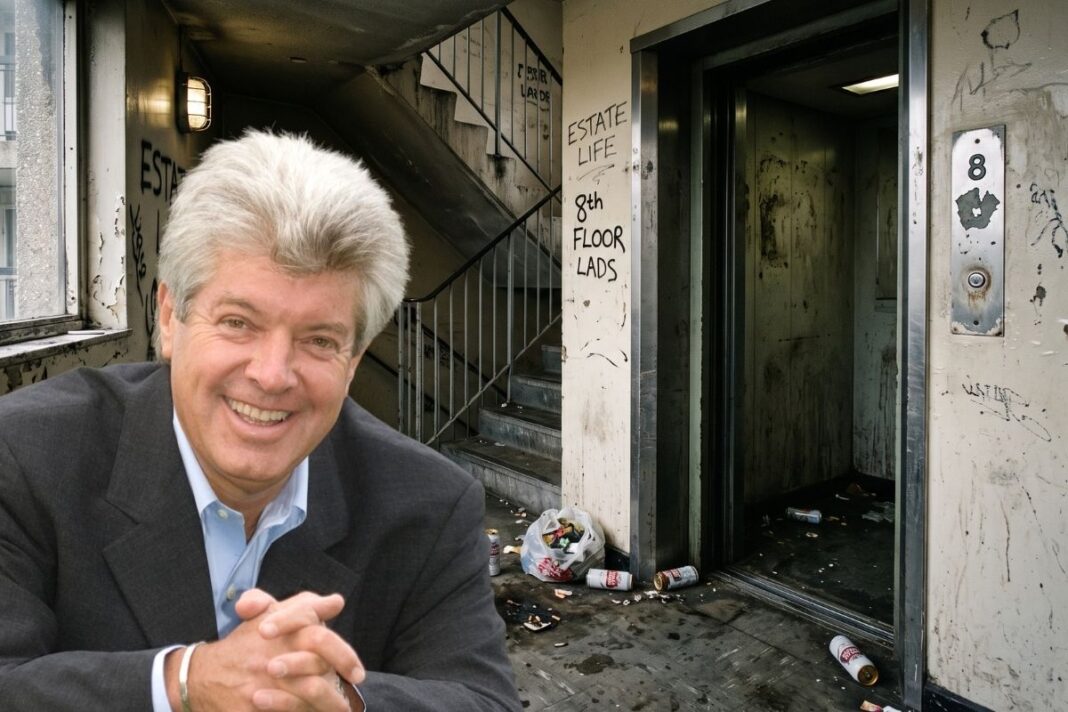
There was a time when getting a council house was not simply about being given somewhere to live, it was a rung on the housing ladder, and, crucially, the aspiration was that it could become one’s home and one’s sanctuary.
Margaret Thatcher was a great proponent of this view and today many blue-collar working families have a very significant nest egg, by means of ownership of their own property, which when finally sold, can provide a quasi-pension, give a ‘leg up’ to their children on the housing ladder and generally make them feel more comfortable in their autumn years.
Let me take you back to the 80s. People who were fortunate enough to buy a council house often took enormous pride in it, and rightly so. They scrubbed the doorstep, polished the front door furniture, tended the garden and treated the immediate surroundings as an extension of their own property.
Why? Because ownership, or the realistic prospect of ownership, changes behaviour. When something belongs to you, you care about it differently than if you were just a temporary custodian of it, by courtesy of the Council.
OWNERSHIP CREATES RESPONSIBILITY
Contrast that with the worst examples of today’s purely rental council estates.
Walk into some blocks and you often encounter the unmistakable, pungent smell of stale cigarettes, rubbish or, occasionally, urine in the lift.
The communal areas are there for everyone, and therefore, psychologically, belong to no-one.
This is not an argument for blaming council tenants. It is more about human nature. Fight it if you will, but it is easier ‘to stop the tide’.
“People generally look after what they own.”
People generally look after what they own. They have a stake in its value, its appearance and its future. Ownership creates responsibility, whereas permanent renting can, in some circumstances, create detachment.
The government is proposing major restrictions, whereby tenants would generally need 10 years of public sector tenancy, discounts would be lower and new social homes would be protected from Right-to-Buy for 35years.
In fact, Andy Burnham is also considering giving Mayors the power to suspend Right-to-Buy in their areas.
A VIRTUOUS CIRCLE
If the problem is that we have too few council houses, the answer is not to make sure that every council house remains permanently in public ownership, it is to build more and let the cycle continue.
A Right-to-Buy sale, even if it is at a discount, releases capital which councils could then re-circulate in order to fund more development of affordable homes. A virtuous circle if you will.
The great success of the Right-to-Buy was not merely that millions of people acquired property, it was that these people were given something extraordinarily powerful and motivating; a personal stake in the place in which they lived.
Can there be anything more desirable than this?
The answer to a shortage of social housing is therefore not to create a permanent, intractable, rental class, but to build more housing and establish more homeowners, for the benefit of all.
WE’VE HEARD IT ALL BEFORE
If we want people to scrub the doorstep rather than complain about the state and smell of the corridors, give them a reason to care and they will respond in kind.
The recent and welcome government initiatives to sequestrate under-utilised land by various nationalised industries, i.e. British Rail, the NHS and educational authorities, allows councils, or third-party house builders, to develop these sites into affordable housing.
This is a very good idea in principle, but if you will forgive me for being cynical, ‘we’ve heard it all before, haven’t we?’
Angela Rayner, in her first morphosis as Housing Minister in 2024 (prior to her debacle with HMRC, underpaying SDLT), made all sorts of grandiose promises to reform the Planning System and get more affordable houses built.
She ‘bet the farm’ that 1.5 million new homes would be built in the first electoral term. Well, we are almost halfway through this period, and we are lucky if 50% of this pledge will be honoured and I am afraid to say that the flow (or should I say trickle) of new homes is slowing, not accelerating.
To quote Benjamin Franklin (1706-1790. One of the founding fathers of the United States): “Well done, is better than well said.”
May I rest my case.