



This is a story about how the Sun, a few trees and 50 million-year-old mud, have become ‘Public Enemy Number One’.
Britain has always had an uneasy relationship with the weather. We complain when it rains, we complain when it snows and now, in a delicious twist of irony, we complain because the sun has had the audacity to shine for more than three consecutive weeks. Boo Hoo!
Who would have thought that the greatest threat to a large, detached house in London would not be burglars, squatters, and the Chancellor but… sunshine? Welcome to the curious world of subsidence and its perils.
For decades we have been encouraged to believe that sunshine is good for us. It lifts our spirits, boosts Vitamin D and fills pub gardens. Unfortunately, nobody bothered to tell London’s clay about the downside of unwanted thermal movement.
LONDON CLAY: A NEUROTIC CREATION
London Clay is one of nature’s more neurotic creations. Give it rain and it swells with the enthusiasm of a Treasury Minister discovering a new tax.
Deny it water and it retreats into itself like a disappointed teenager who has just failed his exams, taking the foundations of several thousand houses along for the journey.
The insurance industry politely refers to this as ‘ground movement’, rather than ‘settlement’, since this is a far less inflammatory term.
Homeowners on the other hand, generally use words which cannot be repeated in polite company for this scourge.
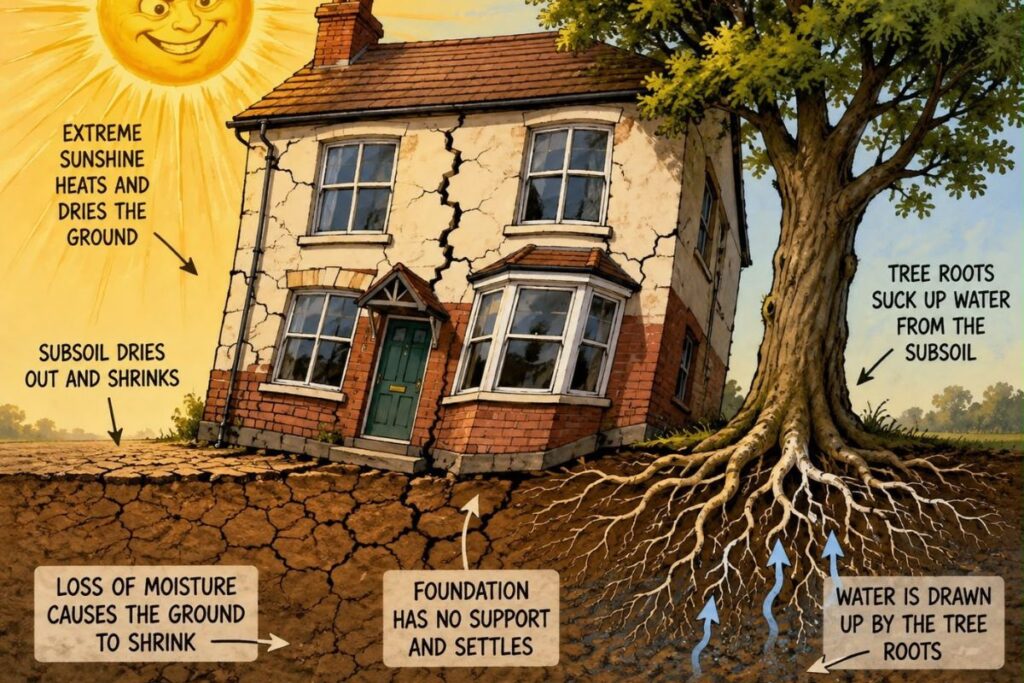
This summer has precisely provided the conditions every loss adjuster secretly dreads. Weeks of relentless sunshine have transformed London’s leafy suburbs into a geological version of musical chairs.
The real villains, however, are no longer criminals – they are the trees.
DRINKING HABITS OF AN INTERNATIONAL RUGBY TEAM
For years local authorities encouraged us to plant more of them.
Every planning application demanded biodiversity, sustainability, greener streets and carbon neutrality.
Councils proudly planted thirsty Oaks, Planes, Poplars and Willows with missionary zeal, while environmental campaigners applauded enthusiastically.
“These botanical saints possess the drinking habits of an international rugby team!”
No one mentioned that these botanical saints possess the drinking habits of an international rugby team after a hot and sweaty game.
A mature Oak, or dare I use the word ‘Willow, can remove hundreds of litres of water from the soil every single day.
As the clay dries, it contracts. Foundations settle, walls crack and insurance claims blossom faster than the trees themselves.
Somewhere in the City of London an Actuary quietly bursts into tears at the thought of this.
The irony is that not all of London suffers this annual geological panic attack.
BAGSHOT SAND: EMOTIONAL STABILITY OF AN ELDERLY SWISS BANKER
For instance, take Hampstead’s sandy heath.Beneath some of London’s most desirable homes in this cherished leafy area, lies the wonderfully unexcitable Bagshot Sand.
Unlike London Clay, Bagshot Sand possesses the emotional stability of an elderly Swiss banker. It neither expands with optimism nor shrinks in despair.
It simply sits there, year after year, century after century, behaving impeccably by not moving a grain.
“Bagshot Sand has probably done more for London than the last 16 Housing Ministers since 2010.”
Indeed, these sandy deposits have rendered a distinguished service to the nation.
They supplied much of the sand used in constructing the City of London during the 17th, 18th and 19th centuries and during the Second World War produced countless sandbags, protecting historic buildings from German bombs.
Bagshot Sand has probably done more for London than the last 16 Housing Ministers since 2010 and it certainly causes fewer problems!
One begins to wonder whether estate agents have been advertising the wrong features for all these years!
Forget underfloor heating; forget cinema rooms; forget wine cellars; the new luxury specification should read: ‘Standing proudly on geologically well-adjusted Bagshot Sand with foundations displaying complete emotional resilience.’
“That alone could add half a million pounds to the value.”
That alone could add half a million pounds to the value. Meanwhile, surveyors have become modern-day archaeologists as they crouch beside microscopic cracks armed with laser levels, glass ‘tell-tales’, and expressions of theatrical concern.
“We’ll need to monitor these cracks”, they declare solemnly, which translated is, “We haven’t the faintest idea whether your house has moved three millimetres or your wallpaper has simply given up the ghost.”
DANGEROUS HYDRAULIC EXTRACTION DEVICE
Then comes the role of the Insurance company, which is more used to handing out umbrellas when the sun shines and then taking them back when it rains.
Having cheerfully accepted premiums for 25 years, they suddenly discover that your magnificent Cedar tree, planted by Queen Victoria’s gardener and admired by generations of neighbours, is in fact a dangerous ‘hydraulic extraction device’ whose roots have apparently been tunnelling beneath your dining room with relentless military precision.
The Assessor arrives carrying a clipboard with the enthusiasm of a tax inspector.
“Regrettably,” he explains, “your policy excludes movement caused by movement.”
One is then left wondering precisely what sort of movement remains insured, perhaps tectonic plates with written permission would qualify!
Climate change, naturally, promises to make matters considerably worse, with longer droughts, hotter summers, and more violent winter rainfall.
These are exactly the sort of conditions guaranteed to send London’s clay into another existential crisis. The insurers know it, the engineers know it and the geologists know it. Only the politicians appear surprised.
ANYWHERE YOU GO
There is a silver lining though: one group who are positively delighted by these developments are the Underpinning Contractors.
For them, every heatwave represents an early Christmas present. Concrete mixers hum contentedly through London’s suburbs, while invoices approach the GDP of a small republic.
The homeowner consoles himself by explaining that underpinning ‘adds value.’ Which is a little like claiming a triple heart bypass is an attractive lifestyle improvement.
And so, the next time the weather forecast predicts another fortnight of glorious sunshine, spare a thought for London’s insurers.
Somewhere, deep beneath the London area, millions of tonnes of London Clay are quietly shrinking, while cracks are widening and premiums rising.
Meanwhile, Bagshot Sand, with characteristic understatement, continues to sit exactly where it has for the last 50 million years, wondering what all the fuss is about!