

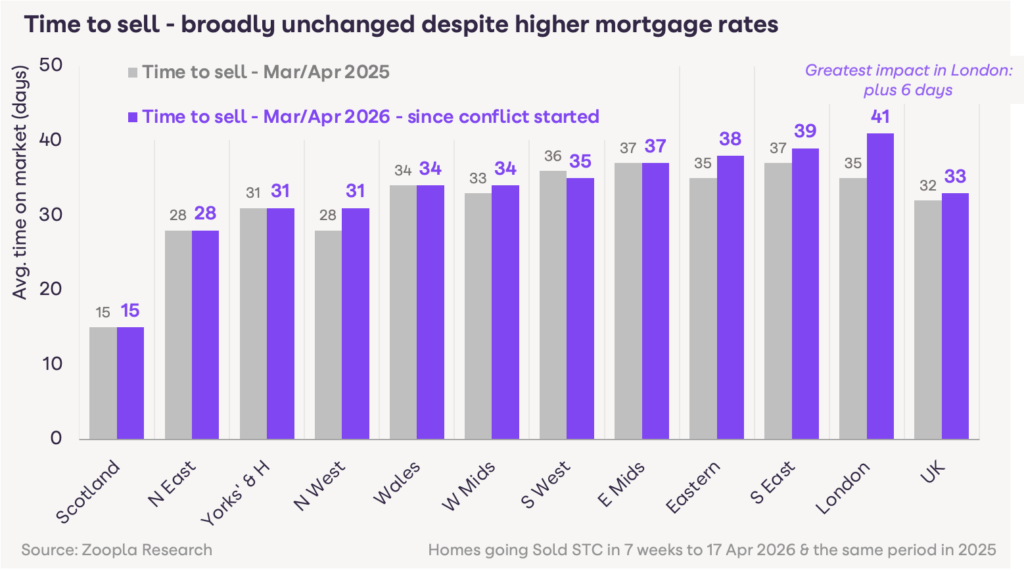
Homes are taking just one day longer to sell than a year ago despite higher mortgage rates and ongoing geopolitical uncertainty.
The latest House Price Index from Zoopla shows the average time to sell now stands at 33 days, broadly in line with last year, while sales agreed are just 3% lower and buyer demand has rebounded following the Easter period.
House price inflation is holding steady at 1.3%, with the average UK property valued at £271,700, as sufficient transaction levels continue to support pricing.
However, London and its commuter belt are diverging from the wider national picture, with longer selling times emerging in markets more reliant on first-time buyers.
SHARP SLOWDOWN
Outer London boroughs have seen the sharpest slowdown, with South East London recording a 34% increase in time to sell, while areas such as Harrow, Uxbridge and Bromley have also seen notable rises.
The trend extends into surrounding commuter towns including Dartford, Slough and Peterborough.
Richard Donnell (main picture, inset), Executive Director at Zoopla, says: “Homes are taking just one day longer to sell than this time last year. That is a strong result given increased uncertainty and mortgage rates rising sharply in March.
“Buyer enquiries have rebounded after Easter and with mortgage rates starting to fall, we expect the market to remain active through the rest of the year. Households who need to move are getting on with it though market conditions vary widely between North and South.”
“Well-priced homes are still finding buyers in the same time as last year.”
He adds: “For sellers, the message is clear – well-priced homes are still finding buyers in the same time as last year across much of the country.
“For buyers, mortgage rates are drifting lower and there is greater choice of homes for sale. The best-value homes are moving quickly, particularly in northern cities and Scotland whereas the room for negotiation is greater across southern regions.”
INDUSTRY REACTION

Nathan Emerson, CEO of Propertymark, says: “On the ground, our agent members are reporting a market that’s holding together better than many expected, but with very different conditions depending on location and buyer type.
“Well-priced homes are still moving quickly, but in first-time buyer hotspots, especially across outer London, agents are seeing hesitation creep in as affordability pressures bite.
“What’s notable is the rebound in enquiries post-Easter, which suggests underlying demand hasn’t disappeared, it’s just more price-sensitive and cautious.
“For property professionals, this means sharper pricing strategies, clearer communication with sellers, and more support for buyers navigating higher upfront costs.
“This isn’t a stalled market, it’s a more selective one, and agents are working harder on behalf of buyers and sellers to keep transactions progressing.”
DOWNWARDS PRICE PRESSURE

Tom Bill, head of UK residential research at Knight Frank, says: “The impact of the Middle East conflict on the UK housing market has not yet fully materialised.
“The disappearance of sub-4% mortgages, a looming inflationary hump caused by higher energy costs and a government reportedly considering responses like rent controls mean the impact will linger for much of this year.
“That will keep downwards pressure on prices and, to a lesser extent, transaction volumes.”
RATIONAL NOT REACTIVE MARKET

Iain McKenzie, CEO of The Guild of Property Professionals, says: “The latest Zoopla HPI underscores just how resilient the UK housing market remains, even against a backdrop of geopolitical tension and elevated borrowing costs.
“A marginal increase of just one day in the average time to sell, is a clear indication that activity has held firm despite two months of conflict in the Middle East and continued mortgage rate pressures.
“What we’re seeing is a market that is behaving rationally rather than reactively. Needs-based buyers and sellers are continuing to transact, underpinning overall stability, while more discretionary movers are understandably taking a more measured approach as they assess pricing and wider economic signals.
“There are early signs of improving conditions.”
“While inflationary pressures and global uncertainty continue to influence sentiment, there are early signs of improving conditions. Mortgage rates have begun to stabilise in recent weeks, and with swap rates easing, lenders are starting to reintroduce more competitive fixed-rate products. This is already feeding into a modest rebound in buyer demand, with enquiries picking up post-Easter.
“Looking ahead, the direction of interest rates will be crucial. However, the data suggests that the market is not only holding steady but is well-positioned to respond positively as financial conditions gradually improve.”
FIRST-TIME BUYER CAUTION

James Nightingall of property search service HomeFinder AI says: “London has one of the country’s most active but also volatile property markets.
“Geopolitical developments and economic factors such as mortgage rates have a major impact on buyer confidence and affordability.
“Particularly first-time buyers, who often depend on favourable lending conditions, are facing more challenging market conditions compared to last year.
“With inflation on the rise and lenders having removed some mortgage deals, the majority of first-time buyers will remain cautious which means some properties will sit on the market for longer.”
SUPPLY AND DEMAND IMBALANCE

Nigel Bishop of Recoco Property Search says: “The rural property markets have seen drastic price adjustments over the past year. Sellers have come to terms with the fact that they can no longer achieve the inflated asking prices seen during the pandemic.
“Adding to property prices seeing a dip is a growing imbalance between supply and demand.
“Higher taxes triggered many second home owners to put their property up for sale.
“In some parts of the country, this has created an oversupply, inevitable creating a buyers’ market that allows more room for price negotiations.”
PROTRACTED TRANSACTIONS

Jeremy Leaf, north London estate agent and a former RICS Residential Chairman, says: “Housing market activity is proving more resilient than we dared hope as war in the Middle East continues for longer than originally anticipated.
“However, the amount of available property in our offices – particularly flats – is keeping prices under control and resulting in more protracted transactions as buyers flex their muscles.
“Worries about the direction of travel for interest rates and the cost of living means more price-sensitive purchasers are taking their time before submitting offers in expectation the after-effects will linger for considerably longer even if hostilities end soon.”