


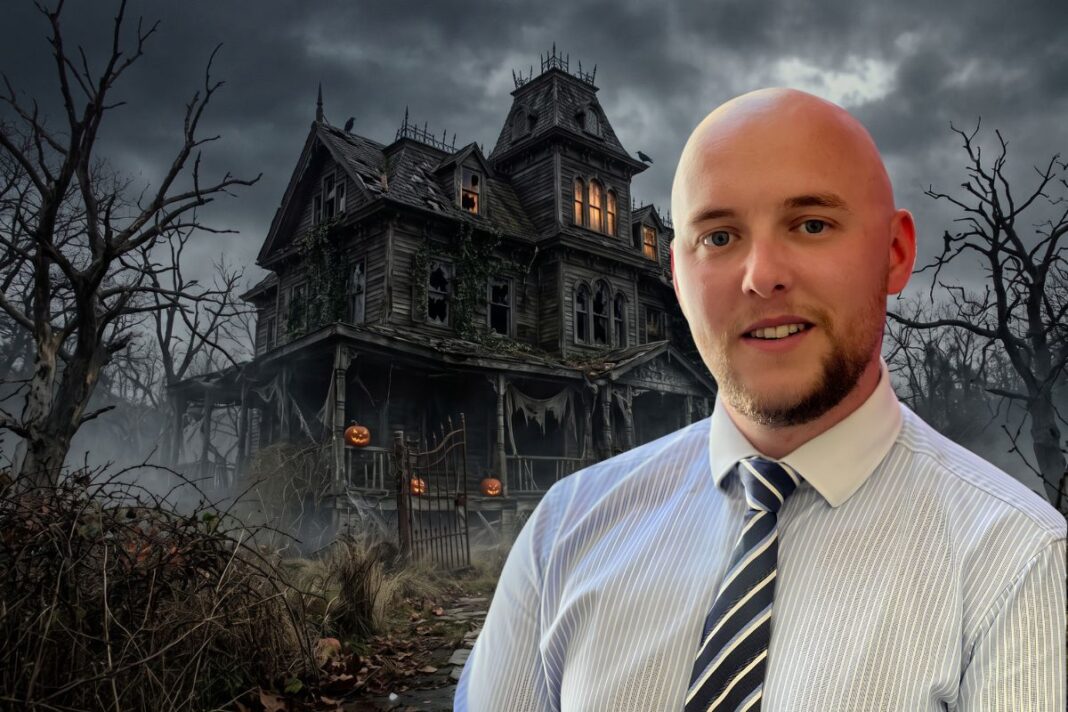
Homeowners don’t have to declare a resident ghost when selling their property – but they should think twice before telling a nervous buyer there has never been anything going bump in the night.
With Halloween approaching, property law firm John Fowlers has explained whether sellers must disclose a home’s supposedly haunted history to prospective buyers.
In England, there is no specific legal requirement to declare paranormal activity, and sellers won’t find a question about ghosts on the standard property information form.
However, that doesn’t mean homeowners can give misleading answers about a property’s history or reputation.
NO GHOSTS BOX
Jordan Kluth (main picture, inset), Property Expert at John Fowlers, says: “There is no specific question on the standard conveyancing forms asking whether a property is haunted, so sellers should not expect to see a box asking them to declare any ghosts or paranormal activity.
“The position in England is different to some of the well-known cases we have seen in the US. What is important is that a seller does not misrepresent the property or give an untrue answer to a buyer.”
The Law Society’s latest TA6 property information form, which became mandatory for Conveyancing Quality Scheme members on new instructions from 30 March 2026, covers matters including boundaries, disputes and alterations.
But supernatural occupants are not among the standard enquiries.
BUYER BEWARE
The issue falls under the broader principle of caveat emptor, or buyer beware, which places responsibility on purchasers to investigate a property’s condition and history.
However, sellers must answer enquiries truthfully and avoid making false or misleading representations.
That means a property’s reputation for paranormal activity could become relevant if a buyer specifically raises questions about its history.
Kluth says: “The safest approach is always to answer enquiries truthfully and speak to your conveyancer if you are unsure about what information should be provided.”
He adds: “If there is something unusual about the history or reputation of the property and you are concerned about whether it needs to be disclosed, you should seek advice from your conveyancer before answering questions.”
For estate agents, the distinction is between an unverified supernatural claim and factual information about a property that may be relevant to prospective purchasers.
And for sellers hoping to complete before Halloween, there is at least some reassurance.
You don’t have to advertise a ghost as an additional occupant – but inventing answers to awkward questions could prove considerably more frightening than the alleged haunting itself.