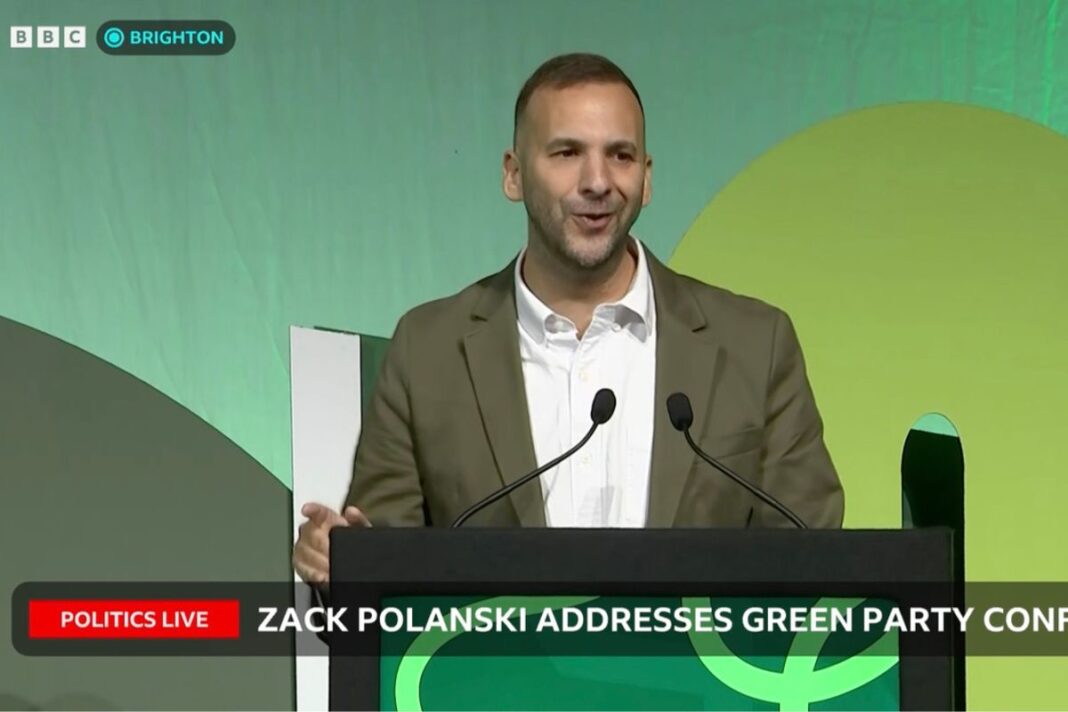
Private rent increases would be capped at no more than 2% for three years under proposals being unveiled by Green Party leader Zack Polanski.
Polanski (main picture) used the Green Party conference in Brighton last week to call for an “emergency brake” under which rent rises would be limited to the lowest of CPI inflation, wage growth or 2%.
The proposed three-year measure would be followed by a longer-term “Fair Rents Guarantee”, with the Greens arguing tenants need protection while wages catch up with increases in housing costs.
Propertymark has warned the proposal risks reducing investment and rental supply without tackling the underlying shortage of homes.
RENT BRAKE
Polanski told the conference: “I’m calling for a three year emergency brake on private rents. No rent rises above CPI, wage growth or 2% – whichever is lower.
“That emergency brake would give renters vital breathing space. Let wages begin to catch up with the rents that have outstripped them for too long.”
The proposal comes months after major reforms to England’s private rented sector took effect under the Renters’ Rights Act.
Around 4.7 million households, comprising approximately 11 million people, rented from private landlords in England in 2024/25, according to the House of Commons Library.
SUPPLY WARNING

Timothy Douglas, Head of Policy and Campaigns at Propertymark, says: “Tenants are facing genuine affordability pressures but rent caps do not address the underlying shortage of homes or the rising costs of providing and maintaining them.
“If policymakers want to make renting more affordable in the long term, the priority must be increasing housing supply and creating the conditions for responsible investment in the private rented sector.
“Propertymark has consistently warned against rent controls because they can have unintended consequences. In Scotland, our members have reported rent increases between tenancies, stalled investment and landlords leaving the market following temporary rent caps.
“Evidence from rent-control schemes internationally also suggests they can reduce investment and the supply of rental homes.
“Any policy to support tenants must therefore consider both the immediate impact on renters and the longer-term need to maintain and increase the supply of homes in an already constrained market.”
SCOTTISH EXPERIENCE
Scotland introduced a temporary freeze on most in-tenancy private rent increases in 2022 before replacing it with a 3% cap from April 2023, with increases of up to 6% permitted in limited circumstances where landlords could demonstrate higher costs.
Those emergency restrictions ended on 31 March 2024.
Scotland has since introduced a separate framework allowing ministers to designate rent control areas where the evidence supports intervention. Under those rules, increases for applicable properties would generally be limited to CPI plus 1%, up to a maximum of 6%, including between tenancies.
Research compiled by the House of Commons Library says opponents of rent controls argue they can discourage investment and maintenance, while supporters argue appropriately designed rent stabilisation can provide tenants with greater security.
It notes that international evidence needs to be considered in the context of the particular form of rent regulation and the housing market in which it operates.