


The average asking price of a newly listed home fell by 2% in August as sellers responded to weaker summer demand and the greatest choice of properties in 12 years, latest Rightmove data reveals.
The £7,360 monthly reduction took the national average to £364,999. August typically produces a seasonal decline, but this month’s fall exceeded the 10-year average of 1.3% and was the largest since 2018.
New seller asking prices are now 1% below their level a year ago, representing the sharpest annual fall since December 2023.
Rightmove has consequently downgraded its 2026 forecast from 2% growth to a movement of between zero and -2% over the year.
SELLERS FACE GREATER COMPETITION
The portal says sellers entering the market during the quieter holiday period are adopting more competitive asking prices from the outset.
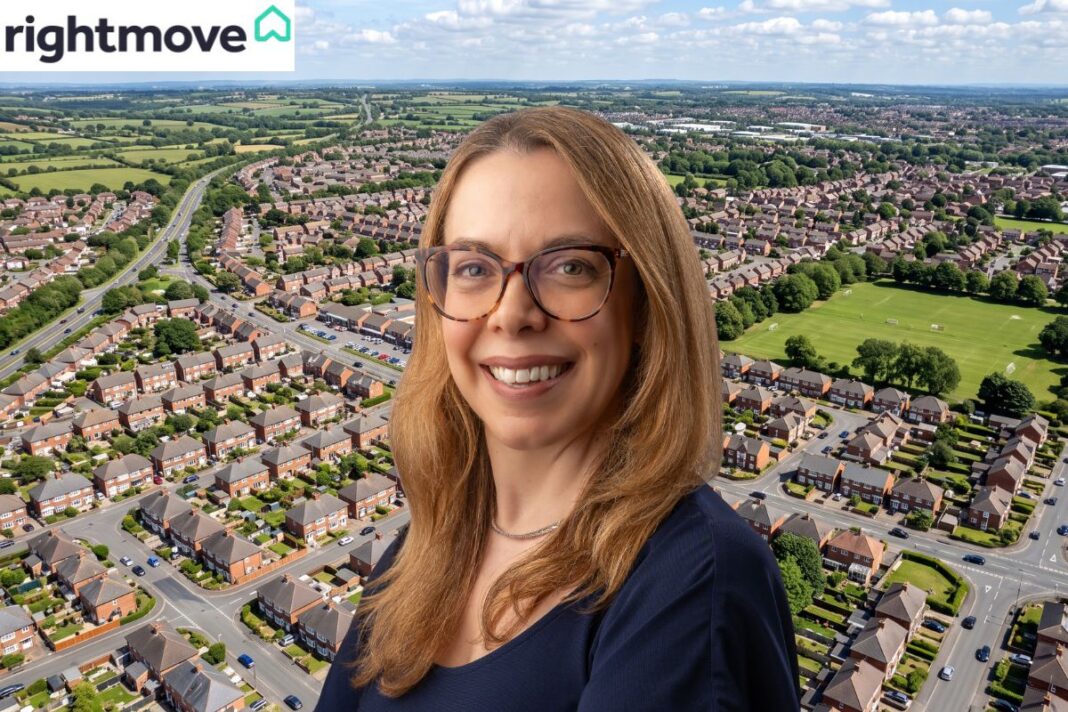
Colleen Babcock (main picture, inset), Property Expert at Rightmove, says: “This month’s larger-than-usual August price drop is a sign that many sellers are recognising the reality of the market and pricing much more competitively from day one.
“Buyers have the widest choice of homes for sale at this time of year in more than a decade, so standing out on price for the right reasons is hugely important.”
NORTH-SOUTH DIVIDE WIDENS
The national figure masks increasingly divergent regional conditions.
Average asking prices across northern England are 1.5% higher than a year ago, led by annual growth of 1.9% in the North West. Southern England has recorded a 1.8% decline.
London is the weakest market, with asking prices down by 3.1% annually and the number of available homes reaching its highest level since 2010.
The capital also faces acute affordability pressures, higher Stamp Duty bills and concerns surrounding flats, including service charges and longer selling periods.
MINI BURNHAM BOUNCE
Buyer demand has increased by 5% since Andy Burnham became Prime Minister on 20 July, compared with a 2% decline during the equivalent period last summer.
However, overall buying activity remains 10% below last year, while the average two-year fixed mortgage rate has risen from 4.92% to 5.09%.
Babcock adds: “The mini Burnham bounce and some renewed general optimism have brought a degree of improvement to the market as a whole in recent weeks.
“Whether that develops into a more sustained recovery will likely depend on confidence, mortgage rates and the new Chancellor’s first Budget this autumn.”
CONFIDENCE HIT

Matt Smith, Rightmove’s mortgage expert says: “Confidence has taken a bit of a hit as fixed-rates remain elevated and return above the psychologically important 5% mark. However, the mortgage market remains highly competitive, with lenders still keen to attract business and support borrowers.
“Many lenders have built greater resilience into their pricing, meaning they are generally better prepared to absorb shorter-term market shocks, which gives movers more stability even during periods of uncertainty.
“There are signs that, because of this additional buffer that lenders have built in, there is some scope for mortgage rates to reduce over the coming weeks, despite the geopolitical landscape still being quite volatile, and they have already started to edge downwards.”
INDUSTRY REACTION

Marc von Grundherr, Director of Benham and Reeves, says: “There’s no denying that London is having a more challenging year than many other parts of the country and affordability is at the heart of it.
“Higher property values mean London buyers feel every pressure point more acutely, whether that’s mortgage costs, stamp duty or the fact that many first-time buyers simply find themselves beyond the useful reach of schemes such as the Lifetime ISA.
“However, I wouldn’t characterise the London market as being in any sort of serious decline. What we’re seeing is a much more price-sensitive market and sellers who acknowledge that are still finding buyers.
“The difficulty arises where asking-price expectations remain anchored to a market that no longer exists, and that is particularly evident within parts of the flat market where buyers are also scrutinising service charges, lease terms and the wider cost of ownership far more closely than they perhaps did previously.”
DEMAND CURBED

Tom Bill, Head of UK Residential Research at Knight Frank, says: “Rising mortgage rates and uncertainty around tax rises in the Budget are curbing demand, which is being felt more acutely in parts of the country where affordability is already stretched.
“The unpredictable events in the Middle East mean there is nothing to suggest mortgage rates will drop materially in the short term, which should continue to keep a lid on prices this year.
“Meanwhile, the government is likely to fund its spending commitments by increasing taxes on wealth and assets, which means the new high-value council tax bands introduced in November’s Budget increasingly look like introductory rates. As a result of these pressures, we recently revised down our 2026 forecast for UK house price growth to 1.5%.”
SUBDUED TIMES AHEAD

Ian Harris, NAEA Propertymark President, says: “Taking a wide-angle view of the property market across the year to date, it comes as little surprise that there has been a dip in overall house prices.
“We have seen global unrest influence household spending, the warm weather potentially impacting viewings, as well as raised concerns around longer-term affordability in areas such as energy prices.
“Although we have seen the base rate hold steady and inflation dip, it has not been enough to ignite wider consumer confidence.
“With reduced mortgage approvals, decreased mortgage lending and an Autumn Budget on the horizon, it may be a case of a slightly more subdued quarter ahead.”
DIFFICULT TIMES

Jeremy Leaf, north London estate agent and a former RICS Residential Chairman, says: “Although asking prices are not selling prices but often reflect owners’, or agents’, aspirational starting points, these figures help demonstrate how difficult it has become to attract genuine buyers.
“Confidence has not been helped by continuing worries about the direction of travel for interest rates and inflation, while speculation about possible tax changes in the Budget is inevitably weighing on decision-making in a price-sensitive market.
“The change in occupier at Number 10 Downing Street has prompted some re-awakening of demand but not enough so far to reduce in sufficient numbers the amount of stock overhanging the market, particularly flats.
“As a result, successful sellers need to go further than just set ‘fairly reasonable’ asking prices or make ‘token’ reductions as part of negotiations if they are serious about generating offers and achieving sales.”