
The mortgage and housing industries have broadly welcomed the Government’s new Your First Home scheme – but warnings are already mounting over new-build supply, price caps, planning, developer contributions and the long-term implications for borrowers.
The proposed scheme is expected to allow eligible first-time buyers in England to purchase qualifying new-build homes with deposits starting at 2.5%, supported by a government-backed equity loan worth 20% of the property price.
The equity loan will initially be interest-free, while household income and local property price caps will be used to target the support. Developers joining the scheme will also be required to contribute towards its cost.
But with much of the detail being held back until the Budget on 28 October, reaction from across the mortgage, estate agency, development and housebuilding sectors suggests the design of the scheme will ultimately determine whether it significantly expands homeownership – or simply increases demand for a constrained pool of new homes.
THE DEPOSIT PROBLEM
There is widespread agreement that the deposit remains one of the biggest obstacles facing aspiring first-time buyers.

Timothy Douglas, Head of Policy and Campaigns at Propertymark, says: “We are pleased to see measures to support first-time buyers onto the property ladder.
“The deposit barrier is a key issue that needs to be tackled, as we highlighted in our evidence to the House of Commons Housing Committee’s recent inquiry into the affordability of homeownership.
“Looking ahead, the UK Government must not lose sight of the fact that not all first-time buyers purchase new-build properties. Additionally, stimulating the buying and selling of second-hand homes can generate greater activity in the wider housing market and bring further economic benefits.”

David Morris, Head of Consumer Lending at Santander UK, says raising a deposit remains particularly difficult for buyers simultaneously paying rent and, in some cases, childcare costs.
Santander already offers its My First Mortgage product at up to 98% loan-to-value.
Morris says: “We know from our own ‘My First Mortgage’ product, which allows lending of up to 98% LTV, that the right practical support can make a real difference in helping those taking their first steps towards buying a home.”

Karl Wilkinson, Chief Executive Officer and founder of Access Financial Services, similarly says that a 2.5% deposit would broaden the options available to some prospective homeowners, particularly those without family support.
But he warns the deposit is “only part of the affordability equation”, with borrowers still needing to consider monthly mortgage affordability and the longer-term implications of an equity loan.

Louise Apollonio, Sales and Distribution Director, Retail Mortgages at Shawbrook, says brokers will therefore have an important role.
She says: “Help to Buy supported many people onto the property ladder, but it also highlighted the importance of buyers fully understanding the longer-term implications of the support available to them.
“As the Government sets out how the scheme will work, it will be important that buyers can clearly see what they may owe over time and whether it is the right option for their circumstances.”
ARE THE RIGHT HOMES BEING BUILT?
A potentially more fundamental problem is whether the new homes available actually match what first-time buyers want and can afford.
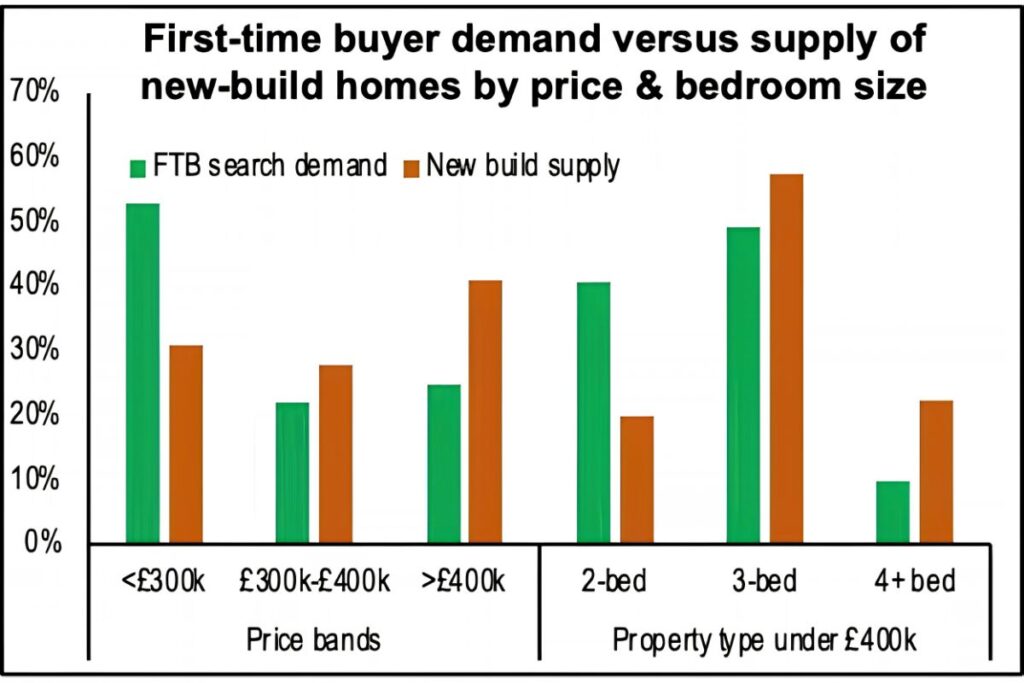
Source: Zoopla Research
Zoopla analysis shows half of first-time buyers searching for two and three-bedroom homes have a maximum budget of £300,000, yet fewer than a third of new-build houses are available below that level.
Among first-time buyers with budgets of up to £400,000, 41% of enquiries are for two-bedroom properties, compared with just 20% of new-home supply.
By contrast, more than 20% of new homes have four or more bedrooms, while these account for just 10% of first-time buyer demand.

Richard Donnell, Executive Director at Zoopla, says: “A new, targeted equity loan would increase the buying power of first-time buyers, but the greatest impact on housing delivery will come if it is accompanied by more homes being built at the price points and in the sizes first-time buyers are looking for.
“The detailed price caps announced at the Budget will therefore be important in determining how much additional demand the scheme can unlock.”
PRICE CAPS WILL BE CRITICAL
That concern over price caps runs throughout the industry’s reaction.

Katy Davis, National Head of Planning at Carter Jonas, says Your First Home was a welcome acknowledgement that increasing housing supply alone will not necessarily help buyers struggling to accumulate deposits.
But she warns: “The test will be whether the scheme reflects the very different markets across England. If local price caps are set too low, buyers could find there are few suitable homes they can actually purchase with it.”

Simon Gerrard, Chairman of Martyn Gerrard Estate Agents, raises particular concerns about London, where significantly higher property values mean buyers typically require larger deposits and incomes.
He says: “The housing market has been in desperate need of support and it’s good to see the Government take action to provide it. These schemes are critical to helping hard-working young people who don’t have access to the Bank of Mum and Dad get on the property ladder. They also provide much-needed certainty to developers, which is key to allowing the country to start building homes again.
“However, I’m concerned by the potential implications of some of the announced changes to the scheme. While setting caps on the household income of those using the scheme and the maximum deposit makes sense to ensure it helps those who genuinely need it, this needs to be done carefully to avoid undermining the entire scheme.
“In particular, the scheme needs to consider the local market context. Property values in London are twice the national average, which means people in the capital need a much larger deposit and a higher income than buyers in Northumberland. If the requirements don’t reflect this reality, it could lock out millions of Londoners from being able to access the scheme despite needing support. This scheme needs to be designed for the whole country and not just the North.
“Further, first-time buyers are only one piece of the puzzle, though an important one. For all the recent talk of an autumn bounce, there’s a noticeable lack of ordinary families buying at the moment. Many second-steppers are struggling to move up the ladder, and Help to Buy only helps first-time buyers purchase new-builds, which means they won’t benefit from the increase in first-time-buyer demand.”

Tim Foreman, Managing Director of Land and New Homes at LRG, says the Government will need to strike a balance between targeting the scheme and making it sufficiently broad to stimulate development.
He says: “Income and local price caps must reach buyers who need help without excluding too many in higher-cost areas, and the terms must encourage developers to participate.”
THE SUPPLY PROBLEM
While Your First Home tackles demand, some of the strongest warnings concern the other side of the housing equation.
Official provisional figures show detailed planning permission was granted for around 212,000 homes in England during the year to June 2026, down 12% from 242,000 a year earlier.

Adam Bovingdon, Managing Director of Real Estate Finance at United Trust Bank, says planning reform will take time to feed through into completed homes.
He says: “The housing market needs both sides of the equation. Supply-side reform is critical, but new homes only get built if there are buyers at the end of the process. A sensible demand-side stimulus alongside planning reform feels like the right approach.”

Neil Leitch, Managing Director of Development Finance at Hampshire Trust Bank, was more forthright.
He says: “Unless government sorts planning, there is a danger much of this becomes pointless. There is little value in stimulating demand for new homes if developers still cannot get viable schemes through the system in a reasonable and predictable way.”
HTB says sales as a proportion of completed stock across its development finance book were improving and fewer funded sites were going two months without a sale.
However, Leitch says planning remains “costly, slow and inconsistent”, affecting the schemes developers were prepared to pursue and where they committed capital.
WHO PAYS?
The Government has confirmed participating developers will be expected to make a financial contribution towards Your First Home, although the details have yet to be announced.
That is already emerging as another potential point of contention.
Leitch says developers were simultaneously facing Section 106 obligations, Community Infrastructure Levy, biodiversity net gain, planning costs and building safety requirements.
“These costs are not experienced in isolation,” he said. “They accumulate within the same appraisal and directly affect viability. Government cannot keep adding costs to the delivery of the very homes it is trying to help people buy.”

Giuseppe Scozzaro, Partner at Goodman Jones, says stronger demand and reservations could improve developer cashflow and potentially make more SME projects viable.
But he says rising construction costs, planning delays, nutrient neutrality and biodiversity net gain continue to affect development viability and timescales.
“Stimulating demand is an important part of the equation, but it needs to be matched by measures that make it easier to build the homes that buyers need,” he says.
LESSONS FROM HELP TO BUY
The industry also has a decade of experience from the previous Help to Buy equity loan scheme to draw upon.
Official figures show 387,195 properties were purchased using Help to Buy equity loans between April 2013 and May 2023, including 328,346 purchases by first-time buyers.
But several commentators warned that the new scheme must avoid unintended consequences associated with stimulating one part of the housing market.

John Davison, Head of Product, Proposition and Distribution at Perenna, says policymakers need to ensure developer contributions did not simply feed through into higher purchase prices.
He also raises a question likely to become increasingly important as the scheme develops: what happens to borrowers after they have bought?
Davison says: “Policymakers also need to think beyond the point of purchase. If house prices stagnate over the coming years, what happens when these borrowers need to refinance?
“Ensuring there is a healthy and competitive market for borrowers at very high LTVs for remortgage will be just as important as helping them get on the ladder in the first place.”
Perenna also wants the scheme structured to encourage competition among mortgage lenders rather than disproportionately favouring larger high street providers.
FROM PERMISSION TO PURCHASE
For developers, however, greater certainty that completed homes can find buyers could unlock investment.

Michael Clifford, Commercial Director at District & County Investments, says uncertainty over sales rates and how quickly buyers could complete remain a significant issue.
“If this scheme increases the pool of buyers able to purchase a new-build property, that should give developers greater confidence that there will be customers for the homes they are building,” he says.

Dominic Agace, Chief Executive of Winkworth, makes a similar argument, saying housebuilding decisions were made years in advance and developers needed confidence in the eventual sales market.
He says supporting first-time buyer demand could therefore encourage developers to continue bringing sites forward.
Foreman adds: “Planning reform can increase the number of homes approved but developers also need confidence that people can buy them.
“Helping first-time buyers with the deposit and reducing the size of their mortgage could give more households a route into ownership while supporting the sales needed to get new sites building.”
The Government will now face the challenge of turning that broad support into a scheme capable of balancing two objectives: helping buyers who cannot accumulate a large deposit and stimulating the construction of additional homes.
The industry response suggests the 2.5% deposit may ultimately prove the simplest part of Your First Home.
Whether the scheme succeeds is likely to depend on what happens around it – the price and income caps; the eventual cost of the equity loan; lender participation; developer contributions and, crucially, whether Britain’s planning and development system can produce enough of the homes first-time buyers can actually afford.