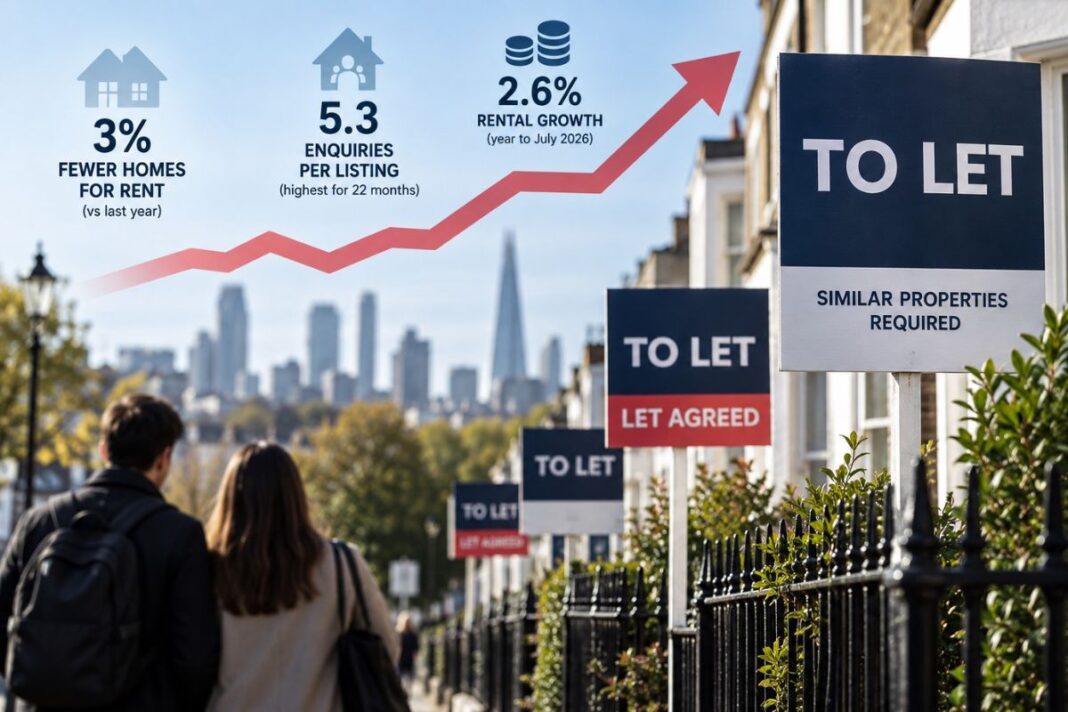
The number of homes available to rent has fallen for the first time in three years as higher mortgage rates keep would-be buyers in the rental market for longer.
Zoopla says UK rental supply started falling in May, bringing an end to a three-year recovery which had helped slow the pace of rent increases.
There are now 3% fewer homes available to rent than a year ago, with supply down 6% year-on-year in August.
Meanwhile, average UK rents have risen 2.6% in the year to July to £1,340 a month, accelerating from annual growth of 1.6% in February. Zoopla expects rental inflation to reach between 4% and 5% by the end of 2026.
SUPPLY SQUEEZE
Competition for properties is also increasing, with enquiries per rental listing 6% higher than a year ago.
The average has reached 5.3 enquiries per listing, its highest level for 22 months.
Zoopla says rental growth is generally accelerating fastest in areas where the availability of homes has fallen most sharply, suggesting reduced supply rather than a substantial increase in demand is the main driver.
Yorkshire and the Humber has recorded a 12% fall in rental supply, while London is down 6%.
By contrast, Wales has seen rental growth slow alongside a 7% increase in available homes.
Zoopla says its analysis does not indicate that the acceleration in rents is being driven by the Renters’ Rights Act, pointing to similar trends of falling supply and higher rental inflation in Scotland.
LONDON PRESSURE
London is proving an exception to the wider supply-led trend because demand and supply are tightening simultaneously.
Rental growth in the capital has accelerated from 1.7% a year ago to 2.9%.
Zoopla estimates the average London buyer now needs an additional £35,500 deposit to offset higher mortgage rates, compared with £18,200 nationally, keeping more prospective buyers renting.
Across inner London, rental demand is higher than a year ago while the number of available homes has fallen 13%.

Richard Donnell, Executive Director at Zoopla, says: “The rental market is starting to tighten again after three years in which the supply of homes for rent has steadily improved and rental growth slowed easing the pressure on renters.
“Our latest report shows how sensitive the rental market is to even modest changes in how many homes are available for rent.
“Higher mortgage rates are not just impacting the sales market, they are keeping more would-be first-time buyers in rented homes for longer, reducing available supply just as the seasonal upturn in demand gets into full swing.
“This is pushing rents higher again, mainly in regions where the availability of homes for rent has declined the most, although affordability remains an important constraint on how far rents can rise.
“The upward pressure on rents is greatest in London, where higher mortgage rates have had the biggest impact on home buyers, and in more affordable rental markets where renters have greater capacity to absorb increases.
“Low levels of new investment by landlords and renters renting for longer mean we expect UK rents to increase by 4–5 per cent by the end of the year. Growing the number of homes for rent through increased investment is the most sustainable route to boosting choice for renters and ensuring stability in rent levels over the long run.”
INVESTOR OPPORTUNITY
Rental growth is also strongest in cheaper markets. Areas where average rents are below £750 a month are recording average growth of 5.4%, more than double the UK rate.
Dumfries has recorded an 11.3% increase, while rents in Carlisle are up 8.8%.
INDUSTRY REACTION

Nathan Emerson, CEO at Propertymark, says: “The latest Zoopla data reinforces the importance of increasing the supply of good-quality homes for rent. As availability falls, competition increases and affordability pressures grow for tenants.
“Higher mortgage costs are also keeping some would-be buyers renting for longer, while landlords continue to face significant borrowing, operating and regulatory costs that can make investment more challenging.
“A sustainable private rented sector requires the right conditions for responsible landlords to invest for the long term. Increasing supply must remain a priority if we are to give tenants greater choice, improve affordability and create a more stable rental market.”
RARE OPPORTUNITY

Allison Thompson, Chief Lettings Officer at LRG, says: “These latest figures reflect the strong level of tenant demand we are seeing, but the real interest lies behind the headline figures, specifically regarding the relationship between the sales and rental markets.
“Higher mortgage costs mean that some tenants are renting for longer than perhaps planned, while a previous dip in landlord investment is limiting replacement stock.
“Yet in London and the South East, falling property prices substantially improve yields. Not surprisingly, we are seeing established investors looking to expand.
“Clearly serious landlords recognise this unusual set of circumstances as a rare opportunity which they are keen to capitalise on.”
SUPPLY AND DEMAND IMBLANCE

Tom Bill, Head of UK Residential Research at Knight Frank, says: “Rising mortgage rates are exacerbating the imbalance between low supply and high demand in the lettings market as more tenants stay put.
“That follows years of tightening supply as landlords left the sector due to a proliferation of red tape and taxes.
“For those who have stayed, the Renters’ Rights Act has aggravated the situation further, with some landlords setting asking rents higher to compensate for the increased risks they face around void periods, rent collection and regaining possession of their property.”
FINAL STRAW

Jeremy Leaf, north London estate agent and a former RICS Residential Chairman, says: “We are not surprised to hear that the pace of rent increases is picking up again, as this confirms what we have seen in our offices over the past month or so.
“Some landlords are selling up when tenants decide to end fixed-term agreements as they are worried about the time it is likely to take to gain vacant possession under the Renters’ Rights Act.
“ For many, this piece of legislation is the final straw on top of the ongoing tax and regulatory burden.
“Landlords are not being replaced fast enough – if at all – which would otherwise keep rents in check.
“Rental demand has been supported by aspiring first-time buyers in particular, who are staying put in rented accommodation for longer due to uncertainty in the sales market. This is resulting in an inevitable further upward pressure on rents.”