
The number of new buy-to-let companies is on course to fall for the first time since 2008 as fewer landlords transfer existing properties into corporate structures.
Analysis of Companies House data by Hamptons shows 41,483 buy-to-let companies were formed across Great Britain during the first eight months of 2026.
That is 8% fewer than the 44,802 established during the same period last year, while August alone recorded a 22% year-on-year fall from 5,363 to 4,198.
If the trend continues for the remainder of 2026, Hamptons says it will mark the first annual decline in buy-to-let company formations for 18 years.
TRANSFER BOOM EASES
The slowdown does not necessarily indicate landlords are moving away from company ownership.
Hamptons says it primarily reflects a decline in existing landlords transferring personally owned properties into limited companies following years of restructuring prompted by changes to the taxation of buy-to-let.
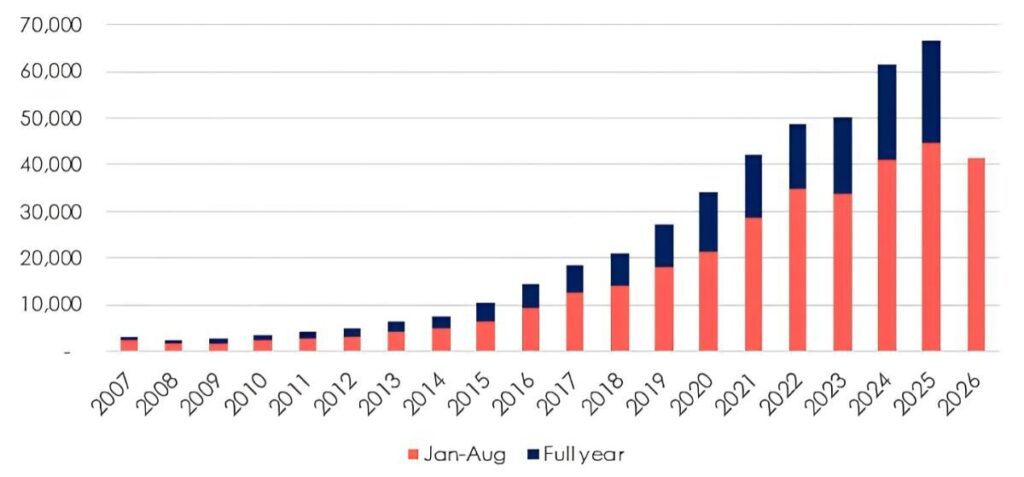
Source: Hamptons and Companies House
In 2025, around 81,800 properties entered buy-to-let companies in England and Wales, with 53% – approximately 43,400 homes – transferred by their existing owners rather than representing new purchases.
Hamptons estimates those transfers generated around £1.2bn in Stamp Duty Land Tax for the Treasury.
That balance is now changing, with an estimated 51% of properties entering companies so far in 2026 representing new purchases rather than transfers.
Despite fewer new incorporations, the total number of buy-to-let companies continues to grow, reaching 469,165 by the end of August compared with 443,272 at the end of 2025.
RENTS ACCELERATE
Meanwhile, Hamptons says rental growth on newly let properties has accelerated for a tenth consecutive month.
The average new rent across Great Britain reached £1,419 a month in August, 2.4% higher than a year earlier and the fastest annual growth since November 2024.
The North also passed the £1,000 threshold for the first time, with the average new rent rising 2.8% to £1,014 a month.
“The arrival of the Renters’ Rights Act seems to be adding further pressure.”
Aneisha Beveridge (main picture), Head of Research at Hamptons, says: “A large part of the buy-to-let incorporation boom was driven by the one-off structural shift whereby existing landlords transferred properties they already owned into limited company structures in response to tax changes.
“But we’re now reaching the tail end of that trend. Increasingly, the landlords who stand to benefit financially from incorporating existing properties have already done so.
“While limited companies remain the preferred structure for most new investors entering the market, it’s likely that new company formations peaked in 2025.”
SDLT RECEIPTS TO FALL
She adds: “Moving forward, growth is likely to increasingly depend more on landlords making new purchases than restructuring portfolios. That also means the Treasury’s stamp duty windfall from these transfers is likely to start falling.
“Rental growth for new lets has been steadily gathering pace for nearly a year now, with much of that increase being driven by markets outside London.
“The arrival of the Renters’ Rights Act seems to be adding further pressure. Higher compliance costs and extra administration have left prospective tenants facing increased prices to secure new tenancies, even while existing renters are seeing more modest increases.”