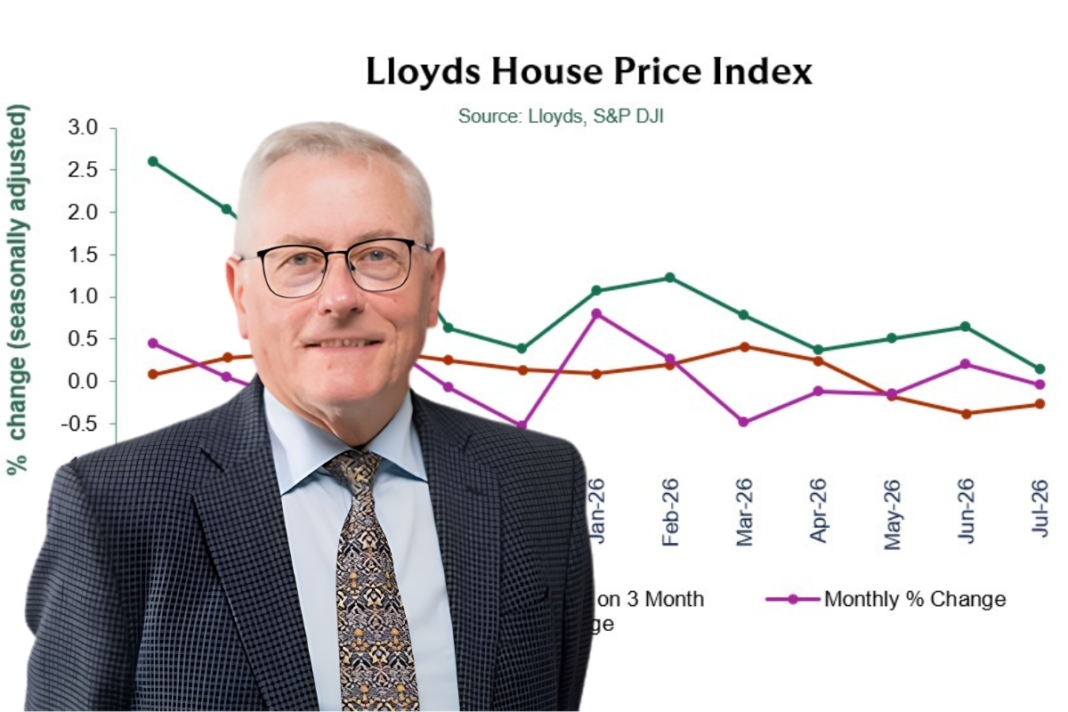
UK house prices remained unchanged during July as renewed global uncertainty and higher mortgage rates continued to constrain the market, according to the latest Lloyds House Price Index.
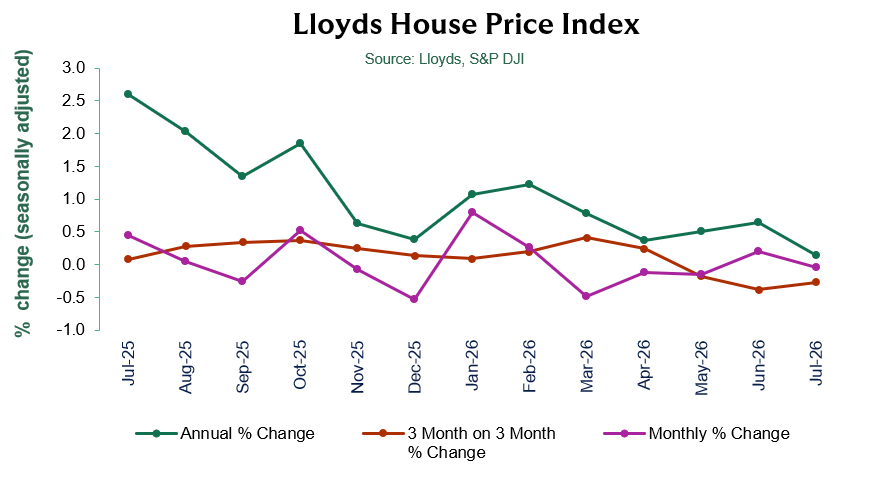
The average property price slipped by £143, from £299,396 in June to £299,253, producing a seasonally adjusted monthly change of 0.0%.
Annual house price inflation slowed from 0.7% to just 0.1% – its weakest rate since November 2023. Prices were also 0.3% lower on a quarterly basis.
The Lloyds House Price Index was previously published as the Halifax House Price Index and is produced using mortgage transaction data in partnership with S&P Dow Jones Indices.
PRICES STABLE FOR ALMOST TWO YEARS
Average prices have moved within a relatively narrow range since late 2024 and are now only 0.5% higher than in November of that year.
Amanda Bryden (main picture, inset), Head of Mortgages at Lloyds, says: “More broadly, average house prices have remained relatively stable for almost two years, moving within a narrow range over that period and sitting just 0.5% higher than they were in November 2024.
“That trend has persisted even as buyers and sellers have faced a more uncertain economic backdrop this year.”
She says affordability remains challenging, while mortgage rates have moved higher following renewed conflict in the Middle East.
NORTHERN IRELAND LEADS GROWTH
Northern Ireland remains the UK’s strongest-performing market, with prices rising by 7.4% annually to an average of £231,131.
Scotland records growth of 3.6%, taking its typical property price to £223,246, while values in Wales increase by 1.6% to £231,458.
Within England, the North East leads with annual growth of 2.8% and an average price of £182,488. Prices in the North West rise by 2.1% to £247,836.
Southern markets remain weaker. Average values fall by 2% in the South East to £381,146, while Greater London records a 1.3% decline to £533,930.
ACTIVITY SHOWS MODEST IMPROVEMENT
HMRC figures show seasonally adjusted residential transactions edged 0.2% higher to 98,700 in June. Mortgage approvals for house purchases increased by 2.9% to 58,200 but remained 10% below their level a year earlier.
Bryden adds: “Looking ahead, we expect market activity and house prices to remain relatively stable over the remainder of the year.
“Developments will be shaped by both how mortgage rates respond to the outlook for inflation and wider household confidence.”
INDUSTRY REACTION

Nathan Emerson, CEO of Propertymark, says: “There is no denying that 2026 has presented affordability challenges for both existing homeowners and first-time buyers. However, buying a home is a long-term commitment, and the housing market naturally does experience fluctuations influenced by wider economic and global factors.
“With interest rates remaining steady and inflation unexpectedly falling last month, conditions may be improving to better support greater buyer confidence as the year progresses.
“However, lower mortgage applications and reduced lending over the previous quarter are likely to continue influencing market activity in the months ahead.
“Economic recovery also has the potential to vary by region, while changing political priorities could shape housing policy differently across individual nations across the UK too.”
SIDEWAYS DRIFT

Tom Bill, Head of UK Residential Research at Knight Frank, says: “The seasonal bounce in house prices was more of a sideways drift this year thanks to rising mortgage costs and renewed political uncertainty around property taxes.
“Budget speculation has calmed down after a land value tax was ruled out but familiar questions remain about which groups the Chancellor will target next.
“The erratic course of the Middle East conflict will also have a bearing on demand as borrowing costs fluctuate but second-round inflationary pressures have so far appeared manageable. Affordability continues to shape the house price map of the UK, with London and the south-east under-performing less expensive regions.”
RESILENT MARKET

Iain McKenzie, CEO of The Guild of Property Professionals, says: “House prices holding steady in July, suggests the market is finding a degree of balance despite an uncertain economic backdrop.
“There are certainly reasons for cautious optimism. Wage growth has remained stronger than many expected, inflation eased during June, and mortgage approvals have picked up, all of which are helping to support buyer confidence.
“At the same time, transaction levels have stabilised and sales agreed are holding broadly in line with previous years, underlining that demand hasn’t disappeared, it’s simply become more measured.
“That said, affordability pressures haven’t gone away. With the Bank of England expected to keep interest rates higher for longer amid ongoing geopolitical uncertainty, buyers remain price-sensitive and are taking a considered approach.
“Sellers who recognise today’s market conditions and price competitively from day one are continuing to achieve successful sales, while those chasing yesterday’s prices are finding their properties linger on the market.”
REGIONAL DIVIDE

Amy Reynolds, Head of Sales at Richmond estate agency Antony Roberts, says: “Although prices remain flat from a national average perspective, there is a regional divide with London and the South East continuing to lag.
“London needs more support from Government, not less. This is where the money is generated, yet policies like the proposed mansion tax disproportionately hit people who are already working long hours and enduring long commutes just to be here.
“ONS figures show over 420,000 people left London for other parts of the UK last year alone, the first real fall in the capital’s population outside of the pandemic in nearly four decades.
“It’s becoming harder to make the case that London is aspirational anymore, and that shift in sentiment matters for the market – buyers are voting with their feet.”
TAX FACTOR

Jeremy Leaf, north London estate agent and a former RICS residential chairman, says: “No fireworks were expected or seen this month as activity continued steadily.
“Wage growth outpacing property price inflation continues to counter-balance the amount of stock, especially flats, overhanging the market as well as concerns over the likelihood of mortgage rate and inflation rises.
“We are increasingly hearing on the ground too speculation about property tax changes in the Budget becoming more of a factor in decision-making.
“The result is a stand-off between buyers and sellers but some price-softening if sellers are serious about getting their transactions over the line.”
SELECTIVE MARKET

Nicky Stevenson, Managing Director of Fine & Country, says: “The latest house price figures show a market that has found a degree of stability.
“Buyers remain active, mortgage approvals are improving, and transactions have edged higher year-on-year, demonstrating that there is still a healthy level of underlying demand.
“However, the market has become increasingly selective. With more properties coming onto the market, buyers have greater choice and stronger negotiating power than they have enjoyed for some time.
“That places an even greater emphasis on accurate pricing, as homes launched at realistic values continue to attract interest and sell, while those that come to market overpriced often require reductions and spend significantly longer waiting for a buyer.
“Looking ahead, ongoing geopolitical tensions, inflation risks and the prospect of interest rates remaining elevated mean we expect the market to continue progressing steadily rather than spectacularly.
“The fundamentals remain supportive, but success for sellers will continue to depend on aligning expectations with current market realities.”
PRAGMATIC OUTLOOK

Jason Tebb, President of OnTheMarket, says: “The steadiness in pricing suggests buyers and sellers are adopting a pragmatic outlook and adjusting expectations.
“For those hoping to get on the ladder for the first time, this is a more opportunistic market to work with, with prices which are not running away with themselves and pricing would-be buyers out further.
“The steady interest rate environment, with the Bank of England holding base rate at five consecutive meetings, is providing a welcome calming effect.
“Affordability concerns remain, particularly as mortgage lenders have increased their rates in recent weeks, but borrowers on the whole are adapting to shifting market conditions.
“Political uncertainty and challenging economic conditions continue to form a backdrop, but the resilience of the market and the needs-based buyers and sellers who have no choice but to proceed, is evident.”
More to follow…