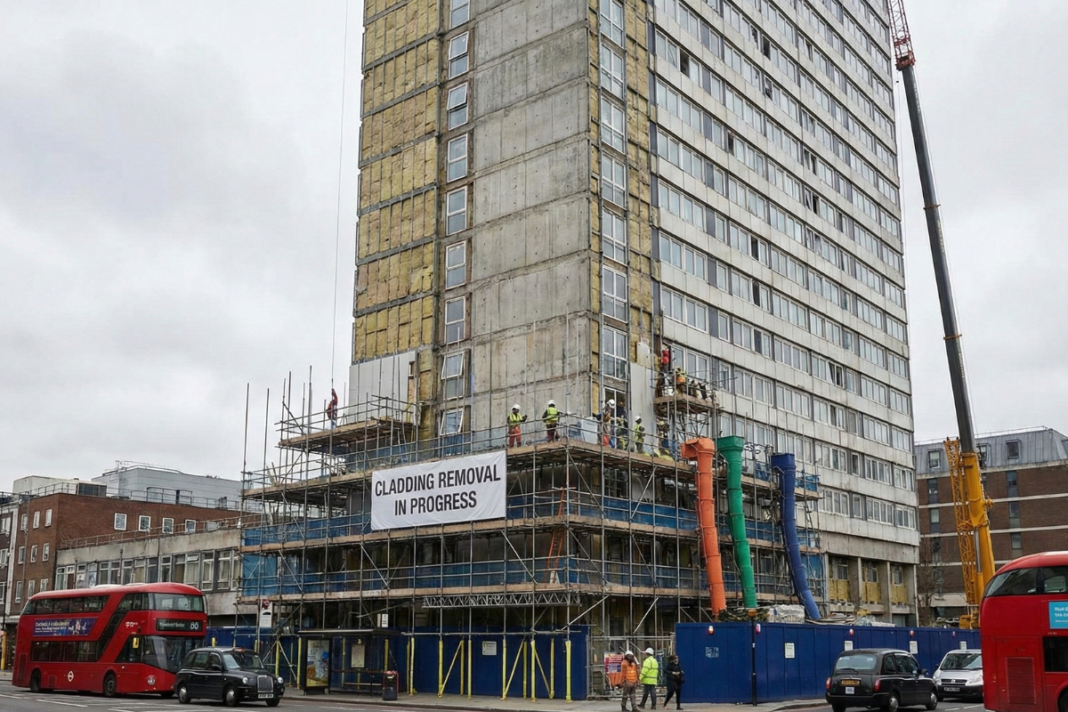
The Building Safety Regulator is stepping up pressure on building owners to accelerate cladding remediation works, warning that tougher enforcement action will follow if progress stalls.
At the centre of the push is the Regulator’s newly established Remediation Enforcement Unit (REU), created in response to the Government’s Remediation Acceleration Plan and tasked with driving faster remediation across higher-risk residential buildings in England.
The unit is initially focusing on around 600 buildings above 18 metres or seven storeys containing combustible aluminium composite material (ACM) or high-pressure laminate (HPL) cladding systems – materials heavily scrutinised following the Grenfell Tower tragedy.
During a recent industry webinar hosted by the Regulator, officials made clear that Principal Accountable Persons (PAPs) will now face significantly greater scrutiny over remediation progress, fire risk assessments and action plans.
FIRE RISK APPRAISALS
The Regulator says the REU will proactively contact building owners and accountable persons to verify building information, review fire risk appraisals and secure time-bound remediation plans.
Sandra Tomlinson, Head of Operations for the REU, says unsafe buildings could not simply be assessed based on visible cladding alone.
“The unsafe is referring to the combustibility of that material and how materials are put together
“It’s not just about any one material. I think it’s very easy to talk about cladding and remediation of cladding. But it’s not just about the cladding.”
BUILDING CONTROL
Alongside remediation enforcement, the Regulator is also attempting to improve the pace and quality of Gateway 2 and Gateway 3 building control applications, which have become a major bottleneck across parts of the higher-risk building sector.
BSR Operational Policy Advisor Josh Paulin told industry attendees that many applications continue to fail due to incomplete information and poor project signposting.
“We have no prior knowledge of your planned project,” he said. “The first time we gain insight is when it is submitted. So, inclusion of a clear project brief with visuals can greatly assist.”
CRUCIAL WORK
He adds: “The regulator really does want to approve your applications, and we really want to work with you to get approvals and for you to carry out this really crucial work that you’re proposing.”
The Regulator has warned that where PAPs fail to assess risks properly or progress remediation reasonably, formal compliance notices and enforcement powers will be used.
The tougher stance reflects mounting political and regulatory pressure to speed up remediation works, with ministers increasingly frustrated by delays across thousands of affected residential buildings nearly a decade after Grenfell.