Bristol has retained its position as England’s leading Japanese knotweed hotspot, recording more than twice the infestation density of any other area.
Analysis by Environet identified 1,324 incidences across Bristol, equivalent to 32.29 per square mile. Merseyside ranked second at 13.45, followed by Greater London at 7.67.
Greater Manchester and Lancashire completed the top five, recording 7.49 and seven incidences per square mile respectively.
The rankings draw on more than 100,000 verified sightings from Environet’s Exposed: The Japanese Knotweed Heatmap, including company enquiries, public records and reports submitted by members of the public.
INDUSTRIAL AREAS DOMINATE
Former docklands and industrial centres feature prominently in the rankings, reflecting the historic movement of contaminated soil through construction and infrastructure projects.
Environet estimates that Japanese knotweed affects 7% of UK homes, equivalent to more than 1.58m properties. Its research suggests an infestation typically reduces a property’s value by approximately 5%, or £13,500.
The invasive plant can also obstruct property transactions, damage buildings and create legal disputes when it spreads across boundaries.
EARLY IDENTIFICATION REDUCES COSTS

Emily Grant, Director at Environet, says: “Japanese knotweed is now firmly established across England, with former industrial and port areas recording by far the highest concentrations.
“While there are significant hotspots in the south such as Bristol and London, the north of England accounts for more than half of the top 20 hotspots by infestation density.
“My advice to anyone living or buying a home in a Japanese knotweed hotspot is to familiarise yourself with what it looks like and check your garden regularly during the growing season.
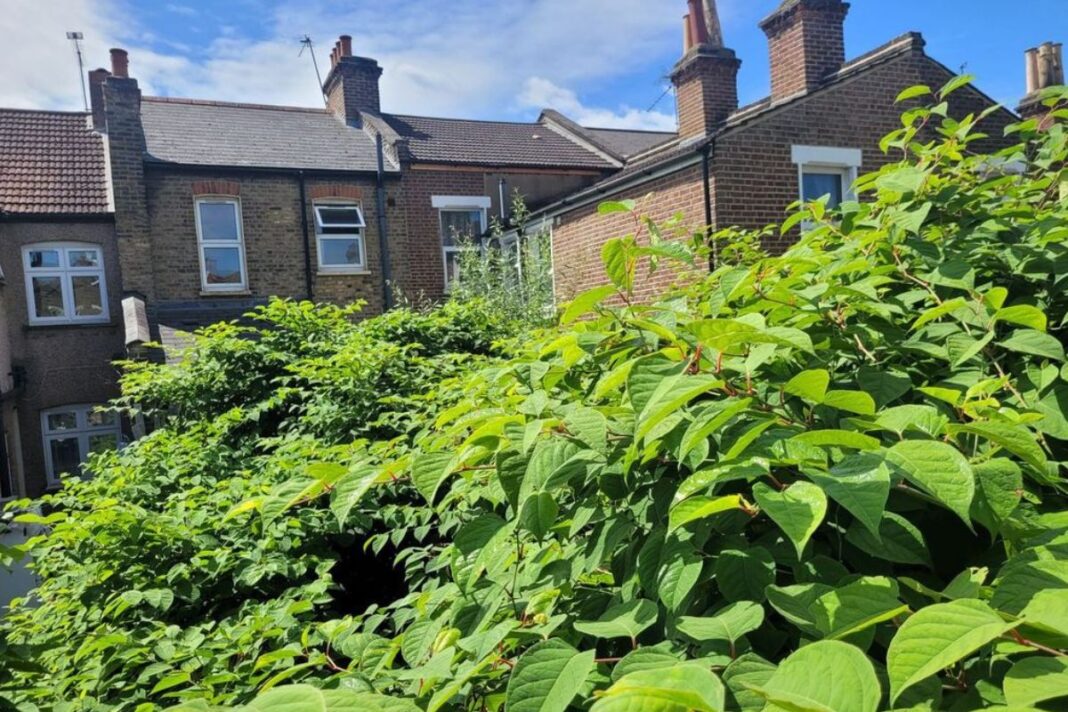
“At this time of year, an established knotweed plant can be identified quite easily by its hard bamboo-like canes and distinctive bright green shield-shaped leaves which grow in a zig-zag pattern along the stem.
“The earlier it’s spotted, the easier and cheaper it is to deal with, and with a professional treatment plan in place homeowners have a much better chance of preserving the value of their property.”
WHAT TO LOOK FOR
During summer, knotweed can grow between two and three metres tall, with dense clusters of upright, bamboo-like canes.
Its shield-shaped leaves grow alternately along the stems, while tassels of small cream-white flowers generally emerge towards the end of summer.
Environet advises anyone who suspects an infestation to obtain professional identification and establish its extent before deciding on a treatment plan.
Read more about Japanese Knotweed HERE.