
Media coverage of the bond market has moved from the business pages to the front pages in recent days, which is rarely a good sign.
Government borrowing costs have risen across developed countries as investors become concerned about inflation risks and debt burdens against the backdrop of the Middle East conflict.
The UK has been under added scrutiny due to its tight financial headroom. The yield on ten-year UK government debt exceeded 5.2% this week, which compares to a figure of just under 4.8% in the US. As a result, the Chancellor’s financial buffer has shrunk to £12 billion from £24 billion, Bloomberg reported.
Here’s a 60-second video explaining the predicament by market analyst and Housing Unpacked regular guest, Michael Brown.
HIGHER FOR LONGER
It’s not a good signal for mortgage rates either and the expectation that inflation will stay higher for longer is the key reason they have also risen. We learned last week that the number of mortgage approvals in July was the lowest figure since January 2024, primarily due to rising borrowing costs since the Middle East conflict began.
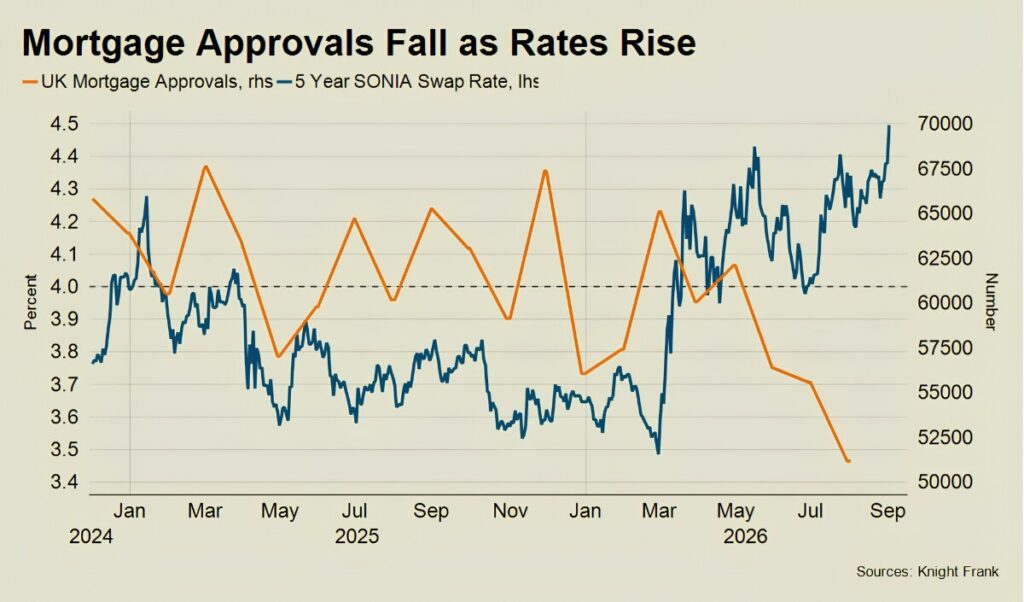
Although that will eventually begin to weigh on sales volumes, activity this summer has been relatively robust so far. The number of transactions in July was only 1% down on last year and 4% up on the same month in 2024, HMRC data shows.
One reason is a change in approach from the government. Following two summers of speculation ahead of the autumn Budget, the new administration should be commended for the absence of media stories about which taxes could rise.

That doesn’t mean, of course, that Chancellor John Healey won’t make changes to high value council tax rates in the Budget, for example.
The relative calm has enabled both cash buyers and mortgage holders to activate their plans as mortgage rates have steadied, at least before the upwards pressure increased this week.
It has been a similar story in prime London postcodes.
The number of transactions in prime central (PCL) and prime outer London (POL) in the three months to August was 2% higher than the five-year average, Knight Frank data shows. The increase versus last year is 18%, although that’s not an entirely fair comparison.
The more domestic and needs-driven market of POL performed better. Transactions were 10% higher than the five-year average compared to a drop of 8% in PCL. Concerns among buyers in higher-value markets like central London include the scrapping of the non dom tax regime, an increase in the second-home stamp duty surcharge and the possibility of future wealth taxes, as I discussed on the last episode of Housing Unpacked.

Despite the uncertainty, activity in PCL is noticeably stronger than last year, said Stuart Bailey, head of prime central London sales at Knight Frank. Sales in the three months to August are 6% higher than 2025, Knight Frank data shows.
“The key difference this year is that buyers are using pre-Budget speculation and bond market jitters to negotiate the price down rather than walk away from the deal completely,” he said.
“The underlying confidence among buyers is there and parts of PCL are extremely good value.”
Average prices in PCL fell by 3.3% in the year to August, having dropped by 23% over the last 11 years. Meanwhile, the annual decline was 0.4% in POL in August, with prices down by 7% over the last decade.
With over seven weeks until the Budget on 28 October, buyers and sellers must be hoping the trial balloons stay grounded, and bond markets stay calm.
The former will be easier for the government to control.
LETTINGS: Super-prime activity resilient as tight property supply weighs on London lettings market
Lettings activity and rental value growth in prime London markets continue to be shaped disproportionately by supply.
Overall, tight stock levels are pushing the number of tenancies agreed lower and rents higher.
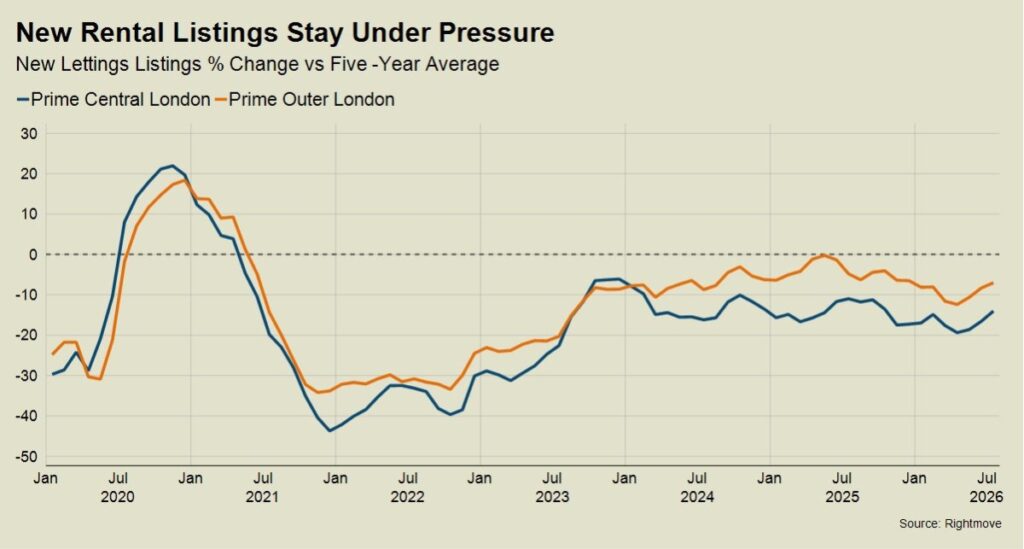
The number of new listings in prime central (PCL) and prime outer London was 10% lower than the five-year average in the three months to August, Rightmove data shows. In fact, new listings haven’t risen above their five-year average since April 2021.
The reason for the decline is a series of tax and legislative changes in recent years that have undermined the viability of letting property for landlords.
For example, the Renters Rights Act, which came into effect in May, sets stricter rules around collecting and increasing rent, reforms the possession process and introduces safeguards to prevent properties being re-let after they have been recovered for sale.
As a result, new lettings activity is also down. The number of tenancies agreed in London in the three months to August was 8% lower than last year, which exactly matched the fall in new supply over the same period, Knight Frank data shows.
The imbalance is less stark in higher price brackets due to the greater number of discretionary owners who can let out their property rather than sell in a weak sales market.
The number of new listings above £1,000 per week in London was 13% higher than the five-year average in the three months to August, Rightmove data shows.
The same effect means that while average rents increased by 3% in POL in the year to August, there was a smaller increase of 1.2% in PCL.
Meanwhile, there were 8.7 new prospective tenants for every new listing in POL in August, which was the highest figure in five years. That compared to a ratio of 5.2 in PCL.
Activity remains strong in the super-prime market above £5,000 per week, which has also been underpinned by weaker demand in the high-value sales market due to the ending of non dom tax status, a rise in the additional rate of stamp duty and ongoing concerns around the taxation of wealth.
The flexibility of renting appeals to some high-net-worth individuals, as I discussed on the last episode of Housing Unpacked.

The number of super-prime tenancies started in the three months to August was 13% higher than the five-year average, Knight Frank data shows.
“One of the most consistent themes we are seeing is prospective buyers continuing to defer purchasing decisions and opting to rent for a further 12-24 months,” said Tom Smith, head of super-prime lettings at Knight Frank.
“While concerns around non-dom reforms and wider tax policy remain relevant, many occupiers continue to adopt a wait-and-see approach.”