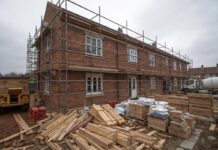
The housing market is showing resilience despite rising mortgage rates with demand and sales holding up as supply reaches its highest level for over a decade.
Data from Rightmove shows the average asking price of a newly listed home rose by 0.8% (+£2,929) in April to £373,971, below the long-term April average of 1.2%.
Higher borrowing costs and increased competition among sellers are limiting price growth, with the number of homes for sale at an 11-year high for the time of year.
Mortgage rates have risen sharply amid geopolitical uncertainty, with the average 2-year fixed rate now at 5.42%, up from 4.25% before the escalation in the Middle East, adding around £235 a month to a typical new mortgage.
STEADY DEMAND
Despite this, buyer demand remains relatively steady. Enquiries in April are running 7% below last year, while the number of sales agreed is just 3% down.
Supply is also holding up, with new listings only 1% behind 2025 levels and 13% higher than in 2024.
Affordability has been supported by wage growth, with average earnings up 3.9% annually, outpacing asking prices, which are down 0.9% year-on-year. First-time buyer demand has proven particularly resilient, down just 6%.
Price growth is being driven by higher-value homes, while lower-priced regions are outperforming geographically. Scotland recorded the strongest growth, with prices up 4.3%.
SOLID SCOTLAND
Colleen Babcock (main picture, inset), Property Expert at Rightmove, says: “With mortgage rates remaining elevated due to the war in Iran, it’s not a surprise that price growth is proving strongest in parts of the market less exposed to higher borrowing costs, such as top-of-the-ladder homes, while sectors more exposed to interest rates are seeing slower momentum.
“Across Great Britain, Scotland stands out as an example of resilience, with average prices rising by over 4%. Lower average asking prices and a faster home-buying process continue to support price growth in the Scottish market.
“However, for most of the market, the combination of rising mortgage rates and the number of homes for sale being at its highest level for the time of year over a decade, means that competitive pricing is crucial for sellers looking to attract buyer interest and secure a sale this spring.”
COST OF LIVING
And she adds: “Some buyers will be feeling cautious due to cost of living and mortgage rate increases.
“However, the latest data shows that, at least for now, home-movers are largely showing their usual resilience with their housing needs trumping other events.
“While higher mortgage rates negatively affect affordability, many buyers are also benefiting from rising wages, lower house prices and more flexible borrowing criteria than in recent years, which all help affordability.
“Rightmove’s whole of market real-time data highlights that while some metrics are understandably slightly down, the overall market currently remains resilient.”
RATES ARE STABILISING

Matt Smith, Mortgage Expert at Rightmove, says: “At the start of the year there was growing optimism that Base Rate would continue to fall, but that picture has shifted following the conflict in Iran.
“Financial markets are now largely pricing in further Bank of England Base Rate increases this year rather than cuts, which has fed through into higher mortgage rates compared with earlier in 2026 and this time last year.
“The initial shock appears to have passed, with mortgage rates stabilising over the past couple of weeks, but they remain elevated. The next moves will depend on upcoming UK inflation data and how the Bank of England responds. If policy decisions align with current market expectations, a period of relative stability is more likely than meaningful falls.
“Even if external pressures ease, including improved conditions in the Middle East, history suggests mortgage rates are unlikely to come down quickly, meaning higher borrowing costs are set to remain in place for the foreseeable future.”
INDUSTRY REACTION

Jeremy Leaf, north London estate agent and a former RICS Residential Chairman, says: “There’s no question war in the Middle East has had an impact on property market activity with hostilities continuing but not as severe as feared.
“Although the Rightmove data reflects asking, rather than achieved, prices, steeper reductions might have been an early warning of tougher times ahead bearing in mind worries over affordability and especially mortgage rates.
“However, in our offices the negative effects have also been relatively limited to date with the overwhelming majority of sales proceeding as well as new listings and buyer enquiries steady.
“On the other hand, the amount of choice of some property means prices remain flat and transaction times are lengthening. We have been involved in some fairly intense negotiations too with existing as well as new buyers and sellers trying to factor in anticipated increases in costs.
“Looking forward, we don’t expect much to change at least until the beginning of the end of the uncertainty is in sight although even then, the after effects will inevitably linger.”
ECONOMIC UNCERTAINTY

Tomer Aboody, director of specialist lender MT Finance, says: “With mortgage rates fluctuating due to global affairs, along with lower economic uncertainty due to the Labour government, we are seeing a lower number of transactions but only slightly down compared with this time last year.
“With buyers having more options as more homes come to market, prices are still buoyant although rising at a much slower pace. Buyers are slowly realising that the days of virtually “free money” are long gone, and that current rates are actually more or less in line with historical averages, give or take 100 basis points.”
SMALL IMPACT

Tom Bill, head of UK residential research at Knight Frank, says: “The fact mortgage offers last for several months means the spike in borrowing costs has not fully kicked in yet for buyers.
“A seasonal increase in activity, combined with the fact that supply fell more notably than demand in response to the Middle East conflict, has kept upwards pressure on prices and prevented a cliff edge moment for the housing market.
“However, the inflationary shock of higher energy prices will put upwards pressure on rates and keep house prices in check for several months.
“We expect there will be a smaller impact on transaction levels.”
REASONS TO BE CHEERFUL

Marc von Grundherr, Director of Benham and Reeves, says: “London has remained fairly measured over the start of this year and as is often the case, the capital is taking a little longer than many other areas of the market to respond to improving conditions.
“The combination of heightened geopolitical uncertainty and the increase in mortgage rates has understandably caused some buyers to pause for thought, particularly across the higher end of the market where affordability is already stretched.
“However, what we’ve seen is not a collapse in confidence, but a more cautious and considered approach from both buyers and sellers.
“There are still plenty of reasons for optimism. Wage growth continues to outpace house price inflation, lending criteria have improved and, while mortgage rates have edged higher in recent weeks, they remain below where many buyers expected them to be at the start of the year.
London is often one of the last markets to turn, but when momentum does begin to build it tends to do so strongly. We’re already seeing the early signs of that return, particularly in those areas where pricing remains realistic and buyers can still see long-term value.”
PRICE MATTERS

Mark Wiggin, Director of Mark Wiggin Estate Agents, says: “There’s no question buyer confidence has taken a knock after the global events of the past few weeks, but deals are still getting done and people are still moving.
“What really matters right now is price. Homes need to reflect today’s market, not last year’s, and there’s a big difference between being in the market and just sitting on it.
“Buyers start with three things: the price, the photos and how long a home’s been listed.
“If something’s been on the market for more than a few months, buyers immediately assume it’s overpriced. In this market, sellers must respond to that feedback – the market always tells you when the price isn’t right.”
STRONG PERFORMANCE

Polly Ogden Duffy, Managing Director at John D Wood & Co, says: “With the arrival of spring, pricing has become more critical than ever.
“With an increased supply of homes – particularly flats lingering from 2025 – buyers have more choice and are less inclined to engage with overpriced properties, meaning sellers who price too ambitiously risk missing out on serious, proceedable buyers.
“In contrast, the family housing market is continuing to perform strongly, especially in areas with sought after schools, where demand can still outstrip supply and, in some cases, result in multiple bids.
“While mortgage rates are broadly in line with this time last year, tensions in the Middle East are weighing on confidence in the short term. In London, the market has remained resilient, with competition for family homes continuing despite global uncertainty.”
RESILIENT MARKET

Peter Ryder, Managing Director at Thorntons Property Services, says: “The property market across the East of Scotland and Inverness continues to show resilience despite wider economic uncertainty.
“Increased stock levels are giving buyers more choice and easing the intense competition of recent years, helping create a more balanced and sustainable market.
“Well-priced, well-presented homes are still attracting strong interest, and activity is being driven by genuine housing needs rather than speculation, providing stability for both buyers and sellers.”