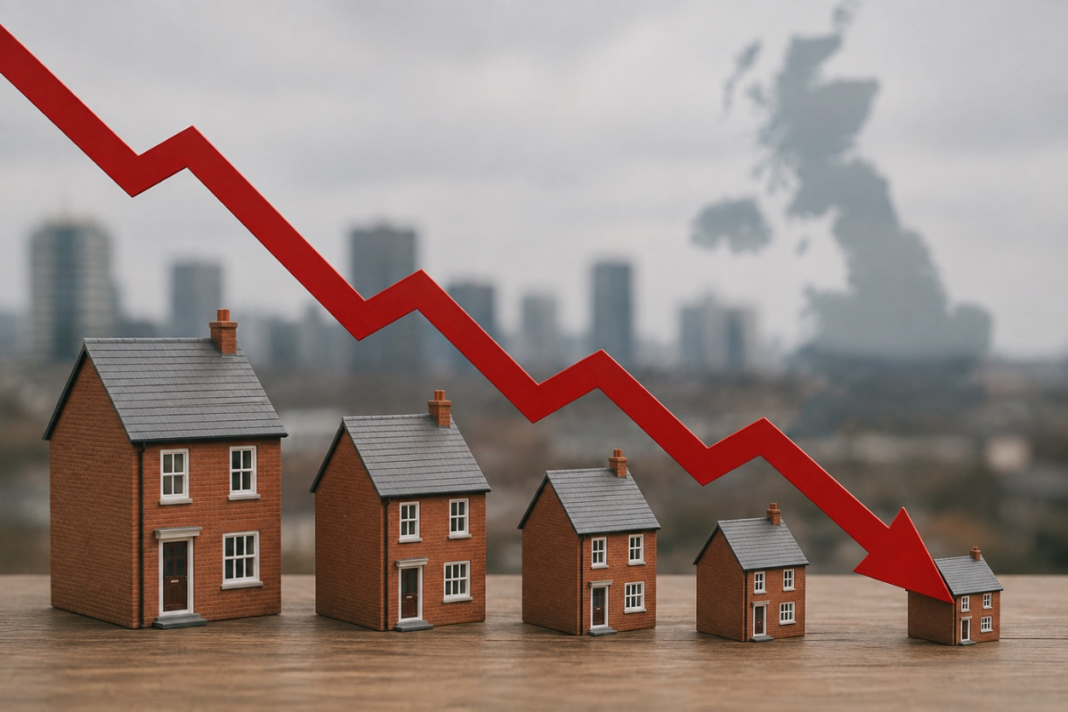
UK house prices were unchanged in September as stronger growth in northern regions contrasted with falling values across southern England.
The average property price edged up from £298,395 in August to £298,441, according to the latest Lloyds House Price Index.
Prices were unchanged both month-on-month and annually, following a 0.3% monthly fall in August.
But the national figure masks a widening regional divide, with Northern Ireland continuing to record the strongest growth while London posted the largest annual decline.
REGIONAL DIVIDE
Northern Ireland prices increased 7.4% over the year, taking the average property value to a record £231,917.
Scotland recorded annual growth of 3.4% to £223,330, while the North East led English regions with a 2.4% increase to £184,546.
Prices in the North West rose 1.9%, while the West Midlands recorded growth of 0.8%.
At the other end of the market, London prices fell 2.2% annually to an average £531,548, while the South East was down 2.1% and Eastern England fell 1.6%.
BUYERS RETURN
Despite the subdued price picture, Lloyds says new enquiries from prospective buyers have reached their highest level since February.
Andrew Asaam (main picture, inset), Mortgages Director at Lloyds, says: “For now, the housing market appears to be balancing buyer caution with continued underlying demand.
“While higher mortgage rates and wider economic uncertainty are encouraging some people to take a more measured approach, new enquiries from prospective buyers are now at their highest since February.”
Housing activity nevertheless remains subdued. HMRC figures show residential transactions fell 1.5% in August on a seasonally adjusted basis, while Bank of England figures show mortgage approvals for house purchases were down 1.8% on the month and 16% annually.
Asaam adds: “That should help sustain activity in the near term, with any movement in house prices likely to remain modest.”

Tom Bill, Head of UK Residential Research at Knight Frank, says: “This year has been a story of rising energy prices and stalling house prices, as the unpredictable Middle East conflict unfolds and drives borrowing costs higher.
“This month’s Budget adds to the uncertainty as buyers and sellers wonder which of the recurring tax rumours proves to be true.
“We think downward price pressure will continue during the final months of the year as the impact of higher mortgage rates feeds slowly through to buyers.”