


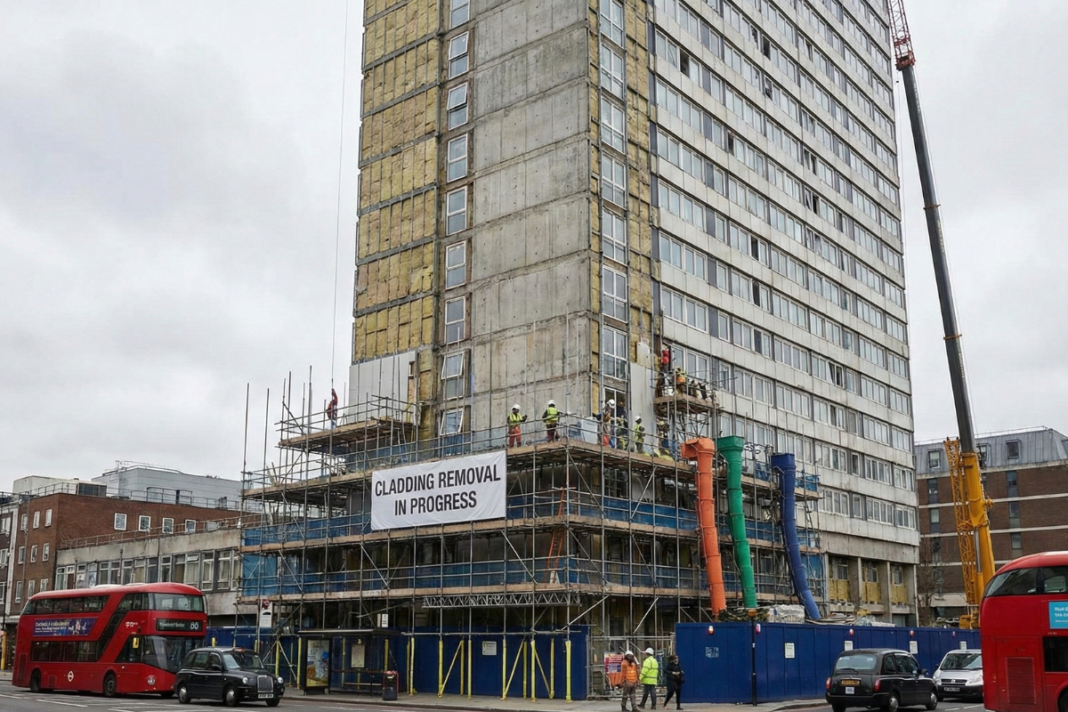
Building owners who fail to address unsafe cladding could face fines of up to £500,000 under new legislation aimed at accelerating remediation and helping leaseholders trapped in unsellable properties.
The Government introduced the Building Safety (Remediation of Unsafe Cladding etc) Bill to Parliament on Wednesday (14 October), proposing tougher enforcement powers against those responsible for making residential buildings safe.
The legislation would introduce new legal duties to identify, assess and address unsafe cladding, with criminal prosecution possible in the most serious cases.
It would also allow public authorities to intervene where responsible parties repeatedly fail to act and strengthen legal routes for recovering remediation costs from construction product manufacturers.
UNSAFE BUILDINGS
The Government says the Bill could accelerate remediation for around 12,000 residents, including approximately 3,000 living in buildings where public authorities may need to intervene.
It follows the completion of remediation work on more than 470 additional buildings since the Government introduced its Remediation Acceleration Plan.
The legislation would also establish a register of medium-rise residential buildings and introduce more consistent assessments of external wall fire risks.
The Government’s ambition remains for every building over 11 metres with unsafe cladding to have completed remediation or a confirmed completion date by the end of 2029.
LEASEHOLD SALES
Propertymark has welcomed the legislation but warns that unresolved building safety problems continue to prevent leaseholders from selling their homes.
Its Leasehold: Still a Life Sentence? report, published in July, found that more than 78% of estate agents surveyed had withdrawn at least one leasehold property from the market because it was unsellable during the previous two years.
The research, drawing on responses from more than 1,200 leaseholders and 200 property professionals, also found that 82% of leaseholders who had experienced defect remediation reported having to contribute financially.

Henry Griffith, Senior Policy and Campaigns Officer at Propertymark, says: “No resident should have to live with uncertainty over their wellbeing or face unnecessary barriers when seeking to resolve issues associated with unsafe cladding and other potentially dangerous building materials.
“Residents must have clear protections against being left to shoulder the financial burden of making their properties safe.”
GREATER ACCOUNTABILITY
The Bill would make it easier for developers, contractors and others who have funded remediation to pursue manufacturers whose products contributed to unsafe buildings.
It would also introduce stronger requirements for responsible parties to communicate remediation plans and proposed timescales to residents.
Griffith says: “The UK Government’s ambition to address some of the remaining challenges around the remediation of flammable cladding is welcome, particularly where industries not covered by previous legislation will now be required to contribute financially.”
However, he says further work is needed to ensure the legislation delivers meaningful progress for leaseholders and provides greater certainty for the property sector.
He adds: “While the Bill is an important milestone for those in England, further work is needed to ensure the legislation delivers meaningful progress for leaseholders, provides greater certainty for the property sector to support flat sales, and helps ensure that as many outstanding building safety defects as possible are remediated.”