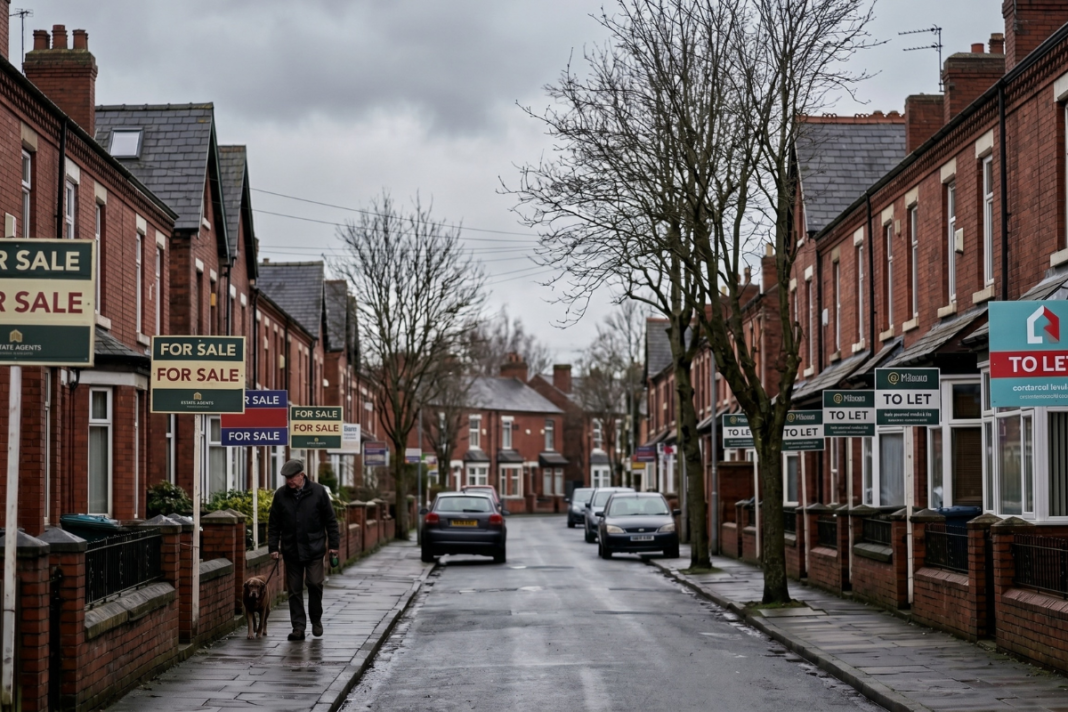
UK house price growth ground to a halt in March, with new figures from the Office for National Statistics showing annual price inflation slowing sharply to 0.0%.
The average UK house price remained at £268,000 in the 12 months to March 2026, down from annual growth of 1.7% recorded in February.
The slowdown came as average monthly house prices fell by 0.4% between February and March 2026, compared with a strong 1.2% monthly increase during the same period a year earlier. The ONS said the slowdown followed heightened market activity ahead of the April 2025 Stamp Duty Land Tax changes introduced in England and Northern Ireland.
England saw house prices fall by 0.6% annually, leaving the average property value at £290,000. But Wales and Scotland continued to record annual growth. Average prices in Wales rose by 2.9% to £213,000, while Scotland saw prices increase by 1.6% to £187,000.
UPWARD RENTAL PRESSURE
Despite the cooling in house price growth, the rental market continued to show upward pressure.
Average UK private rents increased by 3.5% in the year to April 2026, with the average monthly rent reaching £1,381. This marked a slight increase on the 3.4% annual growth recorded in March.
In England, average rents rose by 3.5% to £1,438, while Wales recorded the strongest rental growth of the home nations at 4.9%, pushing average rents to £834.
Scotland saw rents rise by 2.0% annually to £1,019, while Northern Ireland recorded annual rental growth of 4.0% to £877 in the 12 months to February 2026.
Regionally, rental inflation in England remained strongest in the North East, where rents rose by 6.5% annually. London recorded the weakest rental growth at 2.0%.
INDUSTRY REACTION

Nathan Emerson, CEO of Propertymark, says: “Static house prices point to a market that is stabilising after a prolonged period of economic uncertainty and higher borrowing costs
“From an agent perspective, the market remains active but measured. Buyers are continuing to view and make offers, but they are negotiating more carefully and remain highly conscious of value and monthly mortgage costs,
“Sellers are increasingly having to price realistically to generate interest, and homes that are presented well and aligned to local market conditions are continuing to move.
“Stability may help rebuild confidence, particularly among first-time buyers who have been waiting for greater certainty around mortgage rates.”
DEMAND AND SUPPLY
And he adds: “The figures underline the continuing imbalance between tenant demand and the supply of homes available to rent.
While figures released today show an easing of inflation compared to the previous month, rents are still moving upwards because supply remains constrained in many local markets
“Agents on the ground continue to report strong competition for good-quality rental homes, particularly for family properties and homes close to transport links and employment hubs.
“Many landlords are still weighing up rising costs, taxation and regulation, which is limiting the number of homes coming onto the market.
““What we are seeing is a supply issue rather than excessive demand. Without measures that support investment in the private rented sector, affordability pressures are likely to continue.”
BUDGET UNCERTAINTY

Richard Donnell, Executive Director of Research at Zoopla, says: “The ONS index shows house price inflation has stalled – this is a as result of Budget uncertainty over the taxation of housing in the latter part of 2025 as it’s too early for the higher mortgage rates of recent weeks to hit price changes this quickly.
“Looking ahead we expect house price inflation to continue to increase as buyer activity increases with clear evidence of growing sales and increased first time buyer activity as household press ahead with buying decisions.
“The year ahead is on track for 1.2m housing sales, only slightly lower than last year.”
KEEP CALM AND CARRY ON

Kevin Shaw, National Sales Managing Director of LRG, says: “Today’s figures point to a housing market that is keeping calm and carrying on.
“There is plenty going on in the wider economy. Inflation is down, largely because of the energy price cap, but petrol prices are higher, unemployment has edged up and the conflict in the Middle East is creating uncertainty.
“Some will call this the lull before the storm – but that is not what we are seeing on the ground.
“For the sales market, the fact that average house prices are essentially unchanged is not bad news – it is a sign of stability.
“A flat market is far healthier than a volatile one. If house prices are not moving significantly while wages are still rising, then in real terms property is becoming a little more affordable. That is good news, particularly for first-time buyers.
“The interest rate picture also looks more settled than it did a month ago. We are not expecting the Bank of England to move rates in the immediate term. A few weeks ago, a June rate rise looked likely, but now we are looking to a next rise in the autumn, if at all. That pause gives buyers and sellers some much needed certainty.
“Mortgage rates have continued to ebb and flow.”
“Mortgage rates have continued to ebb and flow, but there is healthy competition among lenders and many good products available, particularly targeted at first-time buyers.
“From LRG’s perspective, April was strong and May has started positively. We are not seeing evidence of an imminent dip. Price remains the determining factor, buyers have more choice than they did, supply is healthier and vendors are showing flexibility, all of which creates a market in which deals can happen.
“There is never a perfect time to move. In the last decade, buyers and sellers have had to deal with Covid, Brexit, Ukraine and the ‘disastrous mini budget’ of 2022.
“The difference now is that people seem more philosophical. Rather than reacting to every headline, they are assessing their own circumstances and, where the numbers work, they are getting on with it.”
REMARKABLE RESILIENCE

Jason Tebb, President of OnTheMarket, says: “Property values were flat on an annual basis in April, with the average price unchanged from a year ago.
“Given all that has happened in the past 12 months, this resilience is quite remarkable, with prices kept in check by increased stock, more choice and continued affordability concerns.
“Average prices conceal significant regional differences, with values in London continuing to contract by the greatest margin with a 2.1% fall in the 12 months to March.
“This is mainly due to greater supply of stock and continued stretched affordability with prices considerably higher than other parts of the country.
Needs-based buyers are ploughing on with their transactions, while uncertainty created by the Middle East conflict is resulting in less-committed buyers adopting a more cautious ‘wait and see’ stance. Lenders continue to trim their mortgage rates, but there is still plenty of volatility in Swap rates, which influences mortgage pricing.
“While inflation dipped to 2.8% in the year to April, given the ongoing conflict in Iran this downwards trend is unlikely to be sustained and is tempering market expectations of further base-rate reductions in the near future at least.”
ECONOMIC UNCERTAINTY

Iain McKenzie, CEO of The Guild of Property Professionals, says: “A modest softening in house prices reflects a market that is adjusting to ongoing economic uncertainty, rather than one facing any fundamental weakness.
“Encouragingly, activity levels remain relatively stable, with committed buyers and sellers still moving ahead despite wider geopolitical tensions and inflationary pressures.
“Buyer demand has eased slightly compared to last year, but the market remains far more resilient than many anticipated given the mortgage rate environment. Mortgage approvals are holding up well, transactions have increased month-on-month, and homes are still selling more quickly than they were earlier in the year.
“One of the biggest shifts we’re seeing is a return to a more price-sensitive market. With supply levels now at an 11-year high, buyers have greater choice and are negotiating more carefully, meaning realistic pricing has become absolutely critical to achieving a successful sale.
“There are still reasons for cautious optimism. The Bank of England’s decision to hold rates steady has provided some reassurance, while lenders continue to compete for business and affordability changes are supporting borrowing capacity for many households.
“As a result, we expect the market to remain stable overall, with needs-based movers continuing to underpin transaction levels throughout the year.”
INTERSTING TIMES

Jeremy Leaf, north London estate agent and a former RICS Residential Chairman, says: “This, the most comprehensive of all the housing market surveys as it includes the approximately 40% of cash as well as mortgaged transactions, makes particularly interesting reading this time around.
“The data shows that the Iran War is catching up with buyers and sellers with its inevitable impact on confidence. The latest inflation figures are encouraging but are partly offset by deteriorating employment numbers.
“Overall, on the ground, sales are proceeding but more slowly and taking much longer to complete, with price reductions and renegotiations commonplace.”
COST OF LIVING
He adds: “Though the most extensive of the rental surveys, these figures predate the later, more telling, impact of the introduction of the Renters’ Rights Act from the beginning of May.
“However, on the ground it was clear that the significant number of landlords selling due to concerns about the operation of the new measures meant rents hardened and even rose for some smaller properties due to lack of supply.
“Worries about the cost of living continue to keep landlord aspirations of higher returns in check.”
SUBDUED GROWTH

Nick Leeming, Chairman of national estate agency Jackson-Stops, says: “The latest figures point to a housing market where price growth remains subdued, with affordability pressures and higher borrowing costs continuing to keep buyers highly price conscious.
“While demand remains present, buyers are approaching decisions more cautiously and are increasingly prepared to negotiate harder on pricing, particularly where properties are perceived to be overpriced or require additional investment.
“This is limiting upward pressure on values and, in some areas, contributing to modest price adjustments.
“Compared with this time last year, the market is operating with less urgency and greater emphasis on value. Stronger regional markets and well-positioned homes continue to perform steadily, but sellers are having to adapt to a more competitive and price-sensitive environment overall.
“Looking ahead, the direction of mortgage rates and wider economic confidence will remain central to market performance over the coming months.
“Recently sparked political uncertainty and fluctuations in financing costs are making conditions harder to predict, and we expect buyers to remain selective until there is greater clarity around the interest rate outlook.
RENTS HOLDING FIRM

Amy Reynolds, Head of sales at Richmond estate agency Antony Roberts, says: “Rents are holding firm, and we don’t see that changing any time soon.
“The reason is simple: stock levels remain extremely low while the number of applicants for each available property stays high. Until that supply and demand imbalance shifts meaningfully, landlords have little pressure to move on price.
“When we compare agreed sale prices on a like-for-like basis against equivalent properties this time last year, the difference is not significant.
“The market is more balanced than the data suggests; there is a big distortion from the original asking price, which in many cases is starting out high and applicants are slower to make offers, so there will be a volume drop in sales, but there isn’t a meaningful shift in underlying values.”