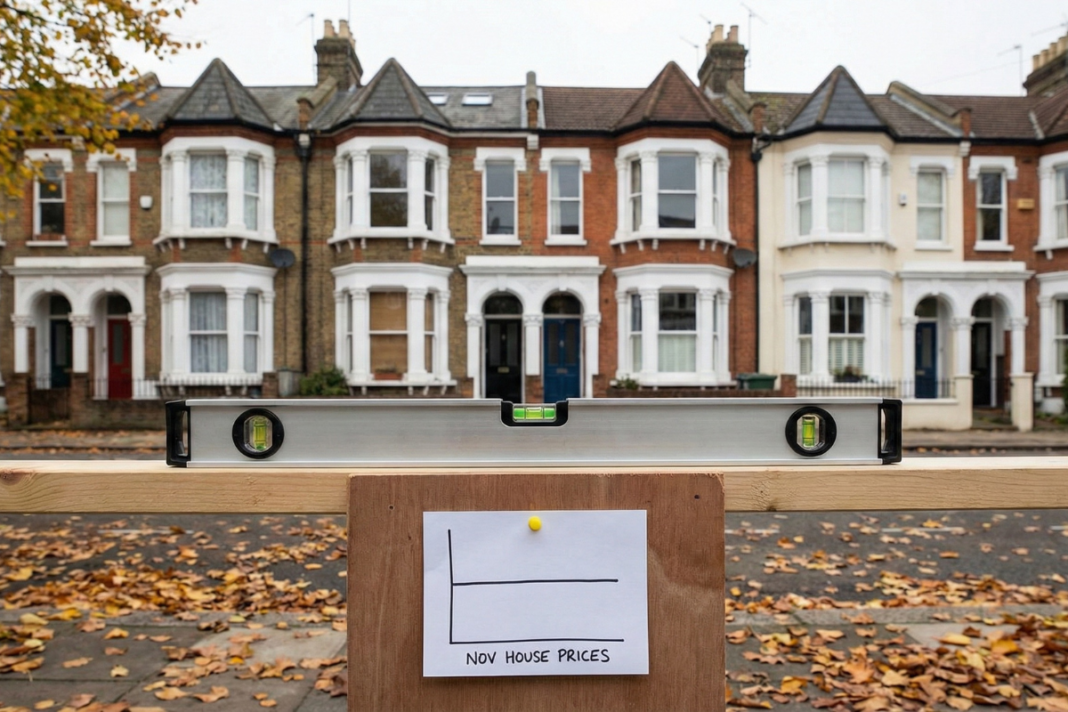
UK house prices were flat in November, pausing after a 0.5% rise in October, according to Halifax’s latest house price index released on Friday last week.
The average UK property now stands at £299,892, a marginal monthly increase of £138 and a new record high.
Annual price growth slowed sharply to 0.7%, down from 1.9% the previous month, the weakest reading since March 2024. Halifax said the slowdown largely reflects the “base effect” of much stronger growth recorded a year ago.
Amanda Bryden, head of mortgages at Halifax, says: “Average house prices were broadly unchanged in November, edging up by £138 compared to October, with the typical property now costing £299,892. Annual growth has slowed to +0.7%, the weakest rate since March 2024, though this largely reflects the base effect of much stronger price growth this time last year.”
FIRST-TIME BUYER BOOST
She adds: “This consistency in average prices reflects what has been one of the most stable years for the housing market over the last decade. Even with the changes to stamp duty back in spring and some uncertainty ahead of the Autumn Budget, property values have remained steady.”

“While slower growth may disappoint some existing homeowners, it’s welcome news for first-time buyers.
“Comparing property prices to average incomes, affordability is now at its strongest since late 2015. Taking into account today’s higher interest rates, mortgage costs as a share of income are at their lowest level in around three years.
“Looking ahead, with market activity steady and expectations of further interest rate reductions to come, we anticipate property prices will continue to grow gradually into 2026.”
NORTH-SOUTH DIVIDE PERSISTS
The regional picture continues to show a marked split. Northern Ireland remains the strongest performing nation or region, with prices up 8.9% year-on-year to £220,716. Scotland saw annual growth of 3.7%, while Wales recorded a 1.9% rise.

In England, the North West led with 3.2% annual growth, followed by the North East at 2.9%.
By contrast, three southern regions saw prices fall in November. London dropped 1.0%, the South East fell 0.3%, and Eastern England edged down 0.1%. London remains the most expensive region, with an average price of £539,766.
Halifax said the data underlines the continuing affordability pressure in higher-priced southern markets, while lower-cost regions are showing greater resilience as activity remains steady heading into 2026.
INDUSTRY REACTION

Nathan Emerson, Chief Executive of Propertymark, says: “While stable house prices suggest the UK housing market is adapting to ongoing political and economic uncertainty, they are still unaffordable for many aspiring buyers, especially with annual regular pay growth at just 0.5 per cent, according to recent data.
“If the Planning and Infrastructure Bill passes its final parliamentary stages on Monday and becomes law before Christmas, it should boost the supply of new homes in England and help moderate prices over the longer term, alongside the devolved administrations’ own building targets.”
LONG-TERM STRENGTH

Verona Frankish, Chief Executive of Yopa, says: “A static rate of house price appreciation in November reflects the holding pattern that the property market found itself in ahead of the Autumn Budget.
“Buyers waited, sellers held back and activity naturally slowed until households knew what the Chancellor had in store.
“That moment has now passed, but what matters most is that house prices continue to rise annually, showing the sector’s long-term strength.
“The Budget didn’t offer the boost many hoped for, but 2025 has already delivered a consistent performance that sets a strong foundation for continued progress in 2026.”
CONTINUED GROWTH

Marc von Grundherr, Director of Benham and Reeves, says: “Whilst house prices were unchanged in November, this was largely expected given the hesitation ahead of the Autumn Budget.
“Whilst the Budget was a largely disappointing affair, the market can now move forward with confidence.
“Most importantly, the annual picture is one of continued growth, which tells the real story of 2025 – a market that has held firm despite all that’s been thrown at it.”
LIMPING TO THE FINISH LINE

Shepherd Ncube, Chief Executive of Springbok Properties, says: “The market coming to a standstill in November provides yet more evidence of the pre-Budget paralysis that has frozen the market in recent months, as buyers and sellers stepped back to wait for clarity.
“Unfortunately, the Chancellor ultimately gave them nothing.
“Whilst the uncertainty may have lifted, we can expect the market to now limp towards the finish line in 2025, with no surge in activity expected to drive us into 2026.”
BUYERS HAVE MORE CHOICE

Iain McKenzie, Chief Executive of The Guild of Property Professionals, says: “What continues to shape conditions on the ground is the higher supply of homes on the market compared to last year.
“Buyers have more choice than they’ve had in years, and that increase in supply is naturally keeping a lid on price growth in the short term.
“We may see some further softening over the winter, but the broader outlook remains reassuring. OBR projections point to average price rises of around 2.5% per year through to 2030.
“All eyes are on the upcoming interest rate announcement.”
“Now that the Budget uncertainty has passed, we expect both buyers and sellers to re-engage with renewed confidence.
“All eyes are on the upcoming interest rate announcement. If the Bank of England moves to reduce the rate later this month, that would provide a welcome boost to market sentiment heading into the key spring 2026 selling season.
“While persistent inflation has kept borrowing costs elevated for longer than many anticipated, the trajectory remains encouraging.
“With CPI forecast to fall towards 2.3% by the end of 2026 and a more stable policy environment now in place, the fundamentals for a modest but steady recovery in activity and pricing are increasingly aligning.”
THE RETURN OF CLARITY

Tom Bill, head of UK residential research at Knight Frank, says: “Both main UK indices show how pre-Budget uncertainty pushed house price growth close to zero.
“Clarity has now returned, but an array of tax rises, which include an income tax threshold freeze, will increasingly squeeze demand and prices.
“Offsetting that is the fact that mortgage rates are expected to drift lower next year as the base rate bottoms out at around 3.25%.”
CONFIDENCE BOOST

Jason Tebb, President of OnTheMarket, says: “The housing market showed considerable resilience this year, shaking off external economic concerns and holding up remarkably well even when the stamp duty concession ended and when speculation was rife as to what property taxes the Budget might contain.
“However, national average figures conceal significant regional differences with the market performing stronger in the north than the more expensive south, where affordability is more of an issue.
“Confidence among buyers and sellers has been boosted by five base rate cuts over the past 16 months.
“Whether there is another reduction this month, or borrowers have to wait until the new year, there is finally a stability in the market which is helpful. Further reductions in base rate will assist with affordability, stimulate the market and encourage activity into the new year.”
BRIGHTER TIMES AHEAD

Jeremy Leaf, north London estate agent and a former RICS Residential Chairman, says: “While some worried about Budget measures and put plans on hold, fortunately enough buyers and sellers have confidence in the longer-term prospects of the housing market and continue with their plans regardless.
“With inflation appearing to have peaked and the direction of travel for interest rates set to be downward in coming months, there are brighter times ahead.”
FULL DIARIES

Amy Reynolds, Head of Sales at Richmond estate agency Antony Roberts, says: “The post-Budget bounce is real and even works when a Budget is in late November.
“Our Saturday diaries are full for all our offices and our most expensive properties have had a new lease of life with viewings booked for most of them and even a second viewing on one already.
“There is more optimism and a feeling of relief now that the Budget is over. Fixed-rate mortgages are slowly heading towards 3.5% and there are better options available including cashback offers from HSBC for first-time buyers.
“While our market appraisals had been low in the run-up to the Budget, we have seen some good houses this week with immediate instructions (ranging from £1.4m to £2.85m) indicating there will be a market in January.
“We’re not predicting huge price rises and a racing market, more a return to the ‘normal’ pre-Budget market which has been on hiatus while everyone waited to see what the Government would roll out.”
SELLERS LISTING EARLY

James Nightingall, Founder of HomeFinder AI, says: “Last month, a lot of house hunters put their search on hold to first evaluate how the Budget will affect them.
“This resulted in sales falling through but also created opportunities as developers promoted incentives and some sellers lowered their asking price.
“Looking ahead, the new mansion tax on homes over £2 million may encourage sellers to list early.
“This would contribute to an increase in the number of available properties for sale at the top end of the market.”