


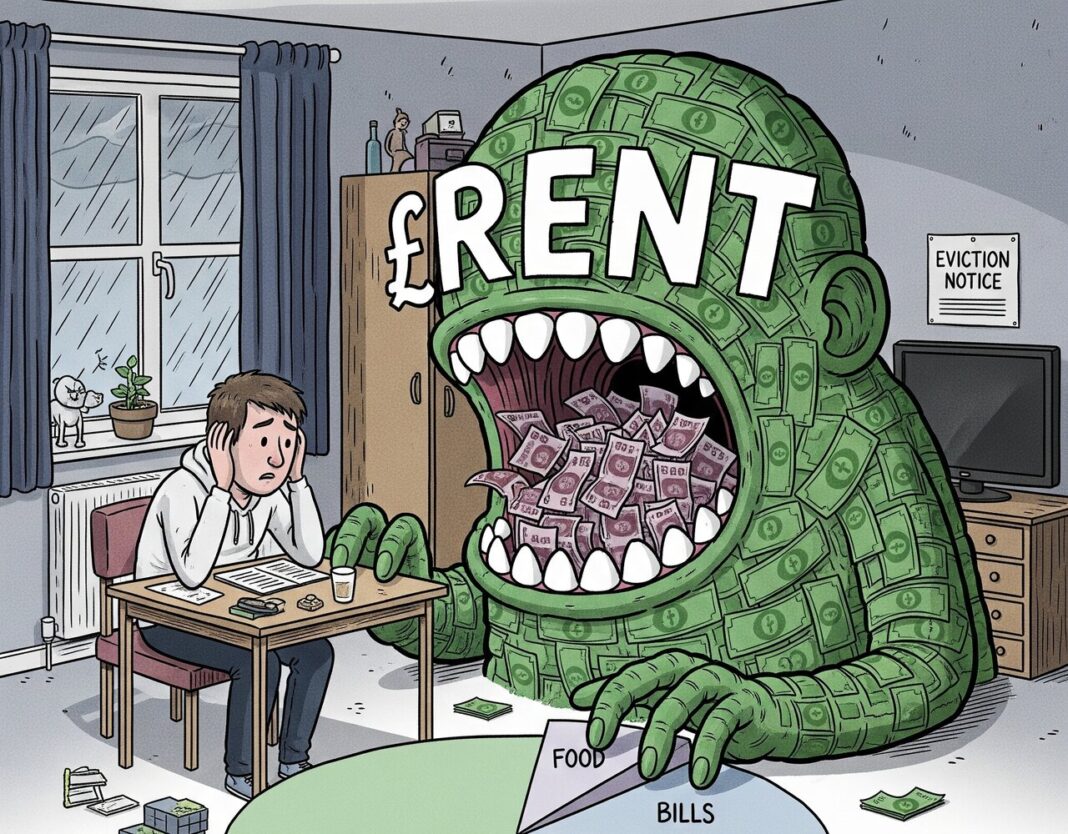
Private renters in England devoted a greater share of their income to housing costs last year than those in Wales and Northern Ireland, according to new figures from the Office for National Statistics.
Median-income households renting privately in England spent 36.3% of their gross monthly income on rent in 2024, compared with 25.9% in Wales and 25.3% in Northern Ireland.
Rental affordability in England has been above the 30% benchmark since 2016, while Wales and Northern Ireland have largely remained below it.
London remains the least affordable part of the country, with renters typically spending 41.6% of income on rent.
AFFORDDABILITY THRESHOLD
While most English regions fall below the 30% threshold, high costs in the capital continue to drive up the national average.
Of the 315 local authorities in England and Wales, 217 – almost 69% – had average rents below the affordability threshold, broadly unchanged from 2023.
But outside London, urban centres and commuter towns such as Bristol, Bath, Brighton, Trafford, Sevenoaks and Watford remain among the least affordable.
Between 2016 and 2021, income growth outpaced rent increases in all three countries. Since 2021, however, rents have risen more quickly in Wales and Northern Ireland, while in England income growth has overtaken rental inflation.
REGULATORY AND FINANCIAL PRESSURES

Megan Eighteen, President of ARLA Propertymark (Association of Residential Letting Agents), says: “Affordability has tightened throughout the UK due to several factors, including rising mortgage rates, increased living costs, and stagnant wage growth in some regions.
“With the average rental price now sitting at £1,344 across the UK, this would mean a renter would need to have a salary of around £40,320 just to qualify to rent a home at this price.
“It’s vital that we address the underlying causes of rising rents directly.”
“It’s vital that we address the underlying causes of rising rents directly. Ongoing regulatory and financial pressures on landlords are driving many out of the market, especially when there is such a pressing need for housing, which is a key factor in the significant rent increases we’re seeing.
“Investment from reliable and professional landlords is essential, as the private rental sector is instrumental in providing housing for the nation. This can only be achieved with the backing and understanding of all levels of government across the UK.”
MORE SUPPLY NEEDED

And Richard Donnell, Executive Director at Zoopla, adds: “The affordability of renting has worsened in 2024 as rapid growth in rents has outpaced the rise increase in household incomes.
“Strong demand for rented homes on higher migration for work and study together with higher mortgage rates has boosted rental demand while the number of homes for rent has remained static for a decade as landlords slow investment.
“The rental supply/demand imbalance remains but growing affordability pressures for renters, especially across UK cities, is limiting the pace at which rents are rising for new lets. Zoopla’s latest rental index shows rents are increasing at 2.7%, the lowest rate for 4 years – since July 2021.
“Lower rent inflation will be welcome news for renters but only by growing the supply of rented homes can the pressures on Britains renters be truly eased.”