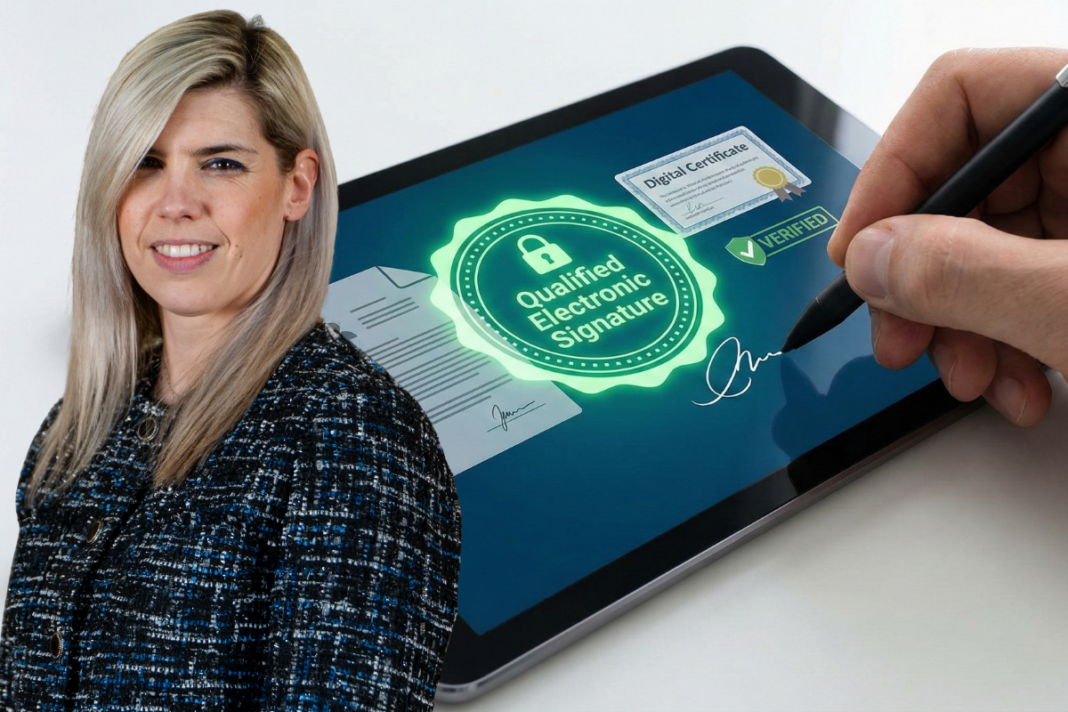
The Land Registry recorded the use of only ONE e-signature in the three months after it invited conveyancers to start using them, it emerged today.
Novus Strategy, a consultancy for the home buying and selling industry, unearthed the finding and says it underlines the fact that businesses have a configuration problem rather than a technology problem when it comes to adoption of digital solutions.
The Land Registry invited conveyancers to start using Qualified Electronic Signatures (QES) at the beginning of August and firms can currently use them for charges, transfers and assents.
In the first three months, no fewer than 1,194,439 applications of all kinds were received by HMLR from 5,964 firms. But only one QES was recorded.
SIGNIFICANT OPPORTUNITY
Novus Strategy CEO Claire Van der Zant (main picture, inset) says QES is a significant opportunity that is vital to the progress of the sector but it’s important not to confuse cause and effect.
To be able to take advantage of QES, firms first need to redesign the customer journey and reconfigure their operations.
In that sense, increasing use of QES would actually indicate that other important steps had already been taken by the industry to unlock the potential of frictionless property transactions, and that takes time and careful planning.
HORIZONTAL DIGITAL INTEGRATION
These wider changes are embodied by what’s known as Horizontal Digital Integration (HDI), of which QES is a key component.
This is the framework that promises to transform the home buying and selling experience, with efficiencies gained through connected ecosystems, trust frameworks and data standards.

HDI brings conveyancers, lenders, brokers and agents together.
HDI brings conveyancers, lenders, brokers and agents together in one joint effort to remove friction and shorten the time between offer to completion.
If approached in this way, fast progress is possible, even in a sector where risk, KYC and compliance touch all areas of operations but the industry shouldn’t expect QES to be the first sign this is happening.
BIGGER CHALLENGE
Van der Zant says: “We were surprised by the lack of uptake but there are practical reasons why adoption would be constrained.
“As consumers, we all understand what an e-signature is and how user-friendly this technology can be. However, for businesses in this space, the challenge is bigger than simply adopting new tools and adjusting internal processes.
“In the case of QES, adoption is impossible without an interoperable digital ID solution. And they will only work effectively alongside wider changes that reduce the friction in the data handoffs between different actors in the transaction.”
“There are almost no QES solutions that combine with that essential digital ID component.”
She added: “Conveyancers would point out there’s very little out there in the way of integrated solutions for QES at the moment, and they’d be right. There are almost no QES solutions that combine with that essential digital ID component.
“And more broadly, they need a strategy that enables data interoperability and trust frameworks beyond their vertical. This is what’s meant by Horizontal Digital Integration, and it involves redesigning the customer journey and reimagining how to connect with the wider ecosystem, solving issues like interoperability, trust and liability simultaneously.
“So digitisation alone isn’t the answer. QES is now available. To fully leverage this opportunity, industry needs to reframe strategies to look left and right of their part of the transaction, embracing HDI as the key framework to unlock opportunities like QES to bring efficiency into the home buying and selling journey.
“It’s encouraging that the Government is introducing digital ways of working, but achieving that adoption requires a different approach.”