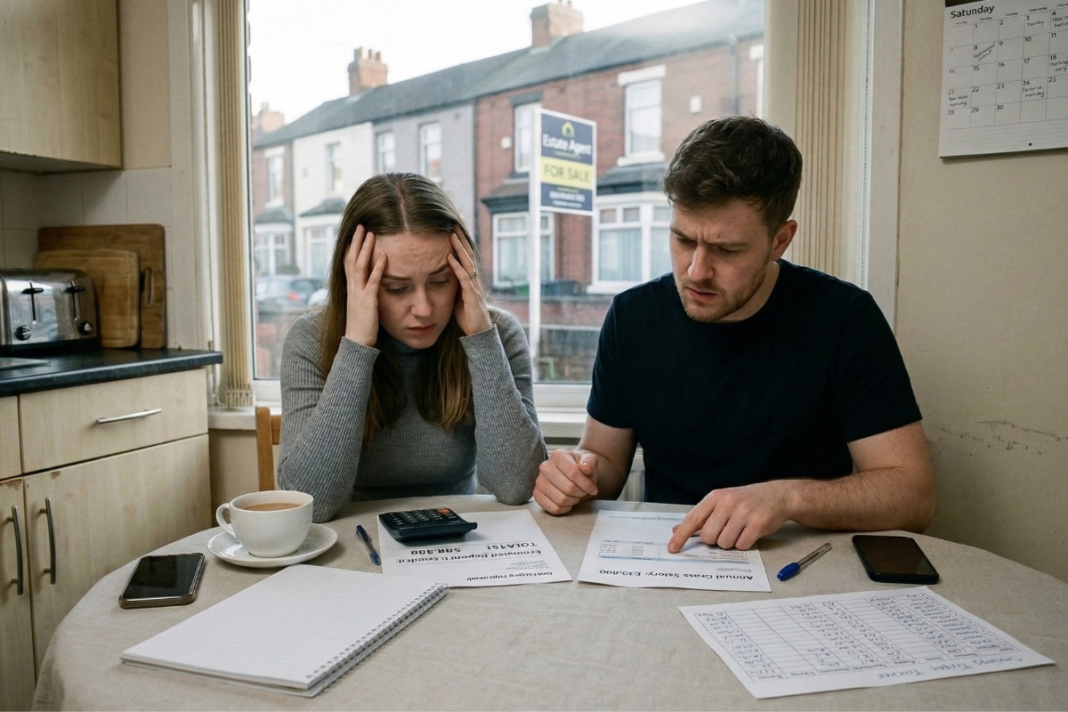
Homebuyers in the majority of Britain’s housing markets now face deposit requirements that exceed the average annual salary highlighting the growing affordability challenge facing prospective buyers.
Research from eXp UK shows that in 62% of local housing markets across Great Britain, the typical deposit required to purchase a home is higher than the average yearly income.
The analysis compared average house price data with earnings across 343 local authority areas and found that in 213 of them – equivalent to 62.1% – buyers must save more than a full year’s salary to secure a deposit.
Across Great Britain, the average house price currently stands at £272,618, based on the latest UK House Price Index figures from December 2026. With a typical deposit requirement of 15%, buyers need to raise around £40,893 upfront.
AFFORDABILITY GAP
However, the average annual salary across Britain is £40,436, meaning the required deposit is already 1.1% higher than the average yearly income.
The affordability gap is most pronounced in London. The capital’s average house price sits at £551,294, requiring a 15% deposit of £82,694. With average annual earnings of £55,033, a full year’s income covers just over half of the deposit needed.
In the South East the average deposit exceeds annual earnings by 27.5%.
Elsewhere in southern England, the challenge remains significant. In the South East, the average deposit exceeds annual earnings by 27.5%, followed by the South West at 25.3% and the East of England at 17.1%.
Even in parts of the Midlands the deposit hurdle remains high, with required deposits exceeding salaries by 2.3% in the East Midlands and 1.3% in the West Midlands.
In contrast, some northern and devolved markets remain more accessible. In the North East, the average salary is 27.1% higher than the typical deposit requirement, while in Scotland earnings exceed the average deposit by 24.8%.

DEPOSIT CHALLENGE

Adam Day, Head of eXp UK and Europe, reckons that the findings show how the challenge of saving a deposit has become one of the biggest barriers to homeownership.
He says: “These figures lay bare the scale of the deposit hurdle facing today’s homebuyers.
“For many aspiring homeowners, the challenge is no longer just meeting mortgage affordability criteria, but accumulating a lump sum that in much of the country exceeds an entire year’s gross income.
“While house price growth has moderated in some areas, deposit requirements remain closely tied to overall values, and earnings simply have not kept pace in large parts of the market.”
INNOVATIVE SOLUTIONS
And he adds: “If we are serious about improving access to homeownership, the conversation has to extend beyond house prices alone.
“Greater consideration must be given to how buyers can realistically build deposits, whether through targeted support, innovative lending solutions or a sustained focus on increasing housing supply.”
“Without that, the gap between aspiration and reality will remain too wide for many households.”