


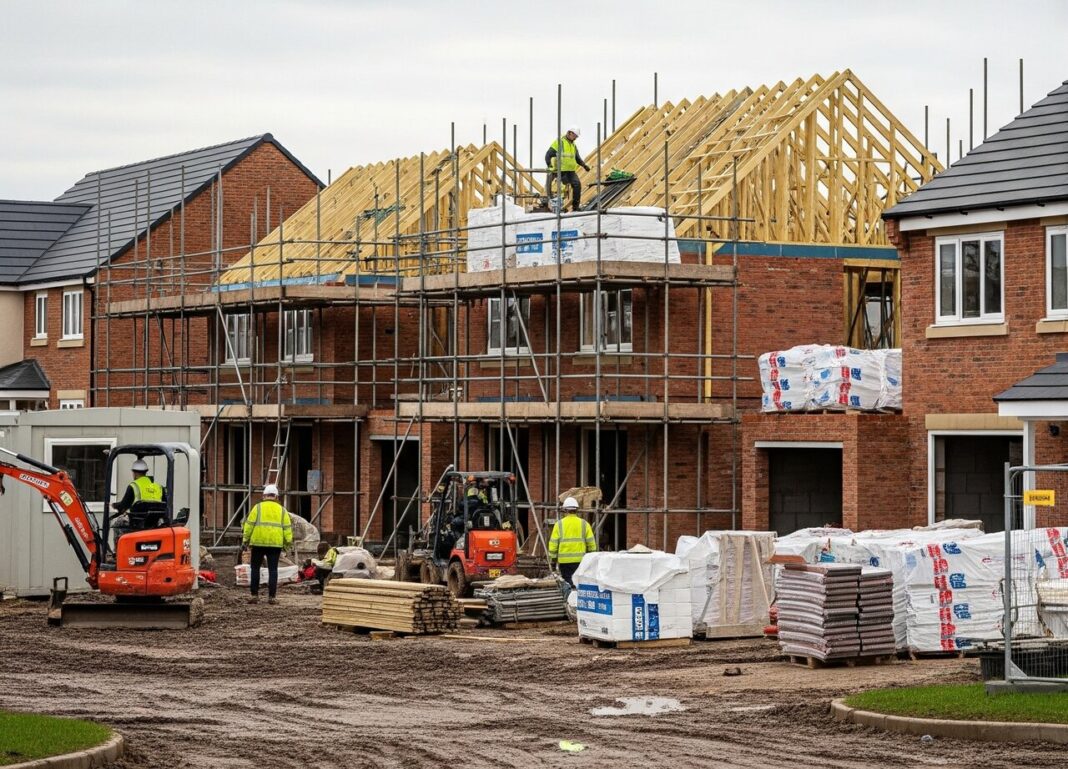
Construction output in Great Britain fell in the three months to October, weighed down by a sharp decline in housing repair and maintenance activity, according to figures published by the Office for National Statistics.
Total construction output is estimated to have declined by 0.3% in the three months to October 2025.
While new work posted marginal growth of 0.1% over the period, this was more than offset by a 1.0% fall in repair and maintenance.
Private housing repair and maintenance was the largest negative contributor, contracting by 2.3% over the three-month period.
CONSTRAINED BUDGETS
Overall, four of the nine construction sectors recorded declines, underlining the uneven nature of activity across the industry.
On a monthly basis, construction output fell by 0.6% in October, reversing a 0.2% increase recorded in September. The decline reflected weakness across both major components of the sector, with new work down 0.7% and repair and maintenance falling by 0.6%.
The figures point to continued pressure on household-led construction activity, as higher borrowing costs and constrained household budgets dampen spending on home improvements, even as new work shows tentative signs of stabilisation.
The data adds to evidence of a subdued construction backdrop heading into the final quarter of the year, with modest growth in new projects struggling to compensate for ongoing weakness in maintenance and smaller-scale residential work.
TIGHTENING VIABILITY

Neil Leitch, Managing Director of Development Finance, Hampshire Trust Bank, says: “These figures simply reinforce what we have seen throughout 2025.

“Housebuilding has struggled to gain any real momentum and the gap between ambition and delivery remains significant.
“Developers want to build, but they are operating in conditions where viability is tightening and the system around them is not providing the clarity or support required to maintain activity.”
UNDER PRESSURE
He adds: Planning remains a significant obstacle and the pressure on the system is growing. A recent study from the Royal Town Planning Institute suggests that one in five planners intends to leave the profession or retire by 2028.
“The system is already stretched and decision times are lengthening. Losing that level of expertise will make it even harder to secure timely approvals, particularly in regions where capacity is already thin. It also widens the gap between the permissions being granted and the number of schemes that actually start on site.
“We are at a point where the sector needs more than a change of tone from government.”
“We are at a point where the sector needs more than a change of tone from government. It needs consistency, capacity and follow-through. There will no doubt be talk of a fresh start in the new year, but we have heard that before.
“Real progress depends on partnership between policymakers, developers and lenders who understand the realities of delivery.
“Construction underpins jobs and economic growth across the UK, and without stability and a functioning planning system the risk is that 2026 becomes another year where output falls well short of what the country needs.”