


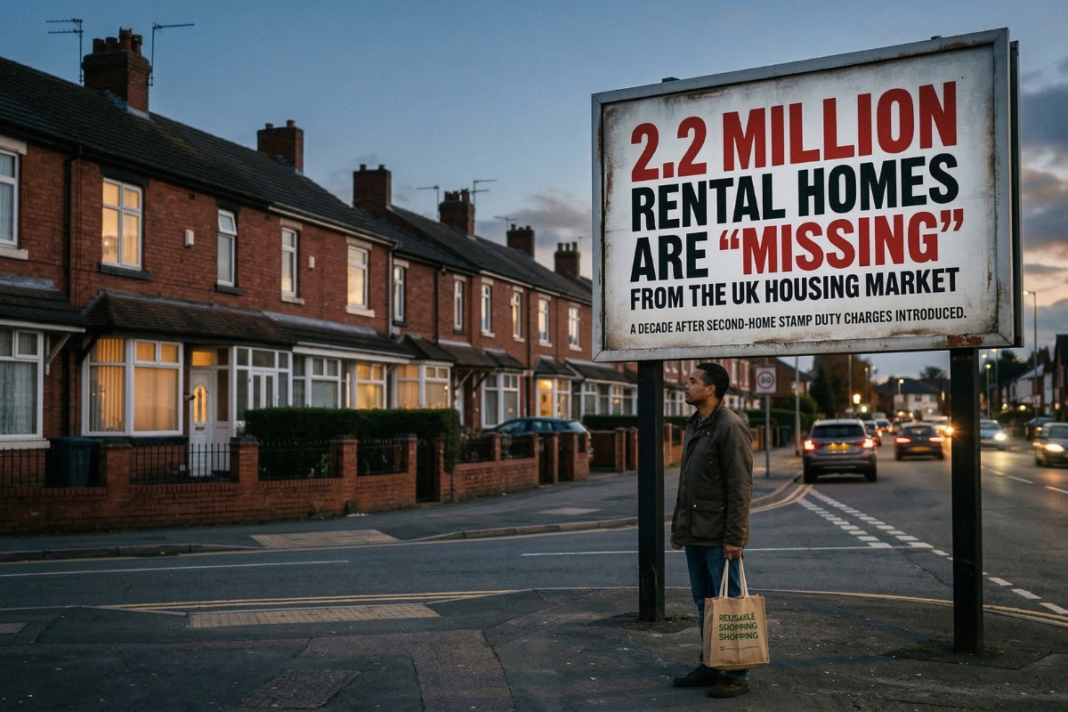
Around 2.2 million rental homes are effectively “missing” from the UK housing market a decade after higher stamp duty charges on second homes were introduced, latest research from Hamptons reveals.
The analysis comes as March marks 10 years since the additional property surcharge was first applied, a policy designed to reduce investor purchases and help more first-time buyers onto the housing ladder.
Hamptons says the measure succeeded in cutting landlord activity, but also slowed the growth of the private rented sector, leaving far fewer homes available to tenants than would otherwise have been expected.
Had the sector continued expanding at the same pace seen before 2016, there would now be around 7.4 million privately rented households across Great Britain instead of the current 5.2 million.
FALLING DEMAND
The firm estimates that the surcharge has added roughly 1% a year to rental growth over the last decade as supply tightened.
Investor demand has fallen sharply over the same period. Landlords accounted for 16.5% of purchases in the year before the surcharge was introduced, compared with just 10.8% so far in 2026, with activity dropping further after the tax increase was raised from 3% to 5% in 2024.
The reduction in investor buying has meant fewer homes available to rent, with rental supply now 25% lower than it was ten years ago, while rents have risen faster than inflation.
First-time buyers have benefited from the shift, with only 19% now competing against landlords when making an offer, down from 26% before the surcharge, although competition has increased in some lower-priced northern markets where investors are still active.
STAMP DUTY SIDE EFFECT

Aneisha Beveridge, Head of Research at Hamptons, says: “Higher rates of stamp duty for anyone buying a second home have broadly delivered what the government of the day set out to achieve.

“Almost overnight, the market tilted away from investors, meaning far fewer homes have been added to the rented sector and more have found their way into owner-occupation over the last decade.
“However, large stamp duty bills have also brought side effects, particularly as the wider tax and regulatory environment for landlords has tightened. Tenants who can’t afford to buy, or don’t want to, have seen rents rise faster than inflation, while those on the margins of the market have found it increasingly difficult to find somewhere to rent in the first place.”
“Domestic and international landlords were once some of the biggest buyers of city centre flats. Prior to 2016, housebuilders often had waiting lists of investors, sometimes years before they even put a spade in the ground.
“Their partial withdrawal has reduced viability and slowed the pace of housebuilding, particularly in the new-build apartment sector, where sales are now taking longer and often completing at lower prices.
LOW AWARENESS
She adds: “With D-Day for the Renters’ Rights Act now less than 50 days away, rental growth has started to creep up. But awareness of the many upcoming changes remains relatively low among landlords, and so far there have been few signs that landlords are looking to push up rents specifically ahead of 1 May.
“Whether the Renters’ Rights Act proves to be inflationary for rents will ultimately depend on how well it works in practise for landlords.”